Studenac Market Conquers Seasonal Chaos Across 1,000+ Locations

From Adriatic Shores to Automated Stores: How Studenac Market Conquered Seasonal Chaos Across 1,000+ Locations

About Studenac Market

One of the top national chains with the largest sales network in Croatia, Studenac Market currently operates more than a thousand stores. It is the leading retail chain on the Adriatic Coast, selling various seasonal and non-seasonal products. A significant portion of their stores are seasonal due to the touristic nature of the region, making effective inventory planning and optimization a critical part of their business.

Benefits

8x 
Planner Productivity Boost

81% 
User Acceptance Rate

8% 
Availability Improvement

15% 
Excess Stock Reduction

55% 
Decrease in Lost Sales

8x planner productivity boost. 81% user acceptance rate. 55% decrease in lost sales. When Croatia’s largest Adriatic retail chain partnered with Solvoyo to automate supply chain planning across its 1,000+ store network, the results spoke for themselves, and they spoke fast.

23K Active SKUs
1,500+
Seasonal Products
450 Stores ​
1,000+
Stores
8K+ Products​
14,000+
Active SKUs
4 Countries​
550
Vendors
Multiple
DCs

The Story

On the Croatian Adriatic Coast, retail doesn’t follow a calendar; it follows the tides. When summer tourists flood seaside towns, demand for everyday essentials can surge 3 to 5 times overnight. And when the season ends, those same shelves need to quietly reset for a different kind of customer entirely.

For Studenac Market, one of Croatia’s top national chains and the leading retailer on the Adriatic Coast, this wasn’t a seasonal inconvenience; it was the defining challenge of the business. With more than a thousand stores, many of them seasonal by nature, Studenac had to get the right products to the right locations at the right time, every single day, across a portfolio of 14,000+ SKUs sourced from 550 vendors and flowing through multiple distribution centers.

And for a long time, most of that planning happened manually.

When Manual Planning Meets a 5x Demand Surge

Behind the scenes, Studenac’s supply chain relied heavily on experience and manual effort. Replenishment decisions were made without a unified system, and the technology backbone was non-standardized. This, combined with inconsistent data, made unified decision-making very difficult.

The cracks showed in predictable ways: excess stock sitting in the wrong locations, lost sales from products that didn’t arrive in time, and planning teams stretched thin trying to keep up with a network that had long outgrown its tools.

When summer hit and demand multiplied across the coast, the pressure wasn’t just operational; it was existential. A tourist who walks into a store and doesn’t find what they need doesn’t come back tomorrow. They walk next door.

Studenac needed more than incremental improvement. It needed a platform that could handle the complexity of seasonal and non-seasonal products across 1,000+ stores, and it needed it fast.

Building the Backbone: Solvoyo's Approach

The partnership with Solvoyo began with an honest assessment of the foundation. Before automating anything, the platform needed clean, connected data. Solvoyo’s team worked to minimize the complexity of Studenac’s fragmented data environment, enhancing data quality and building an intelligent backbone, a single source of truth that could power every planning decision downstream.

From there, the transformation followed Solvoyo’s integrated approach: a configurable, Lego-like platform customized for Studenac’s unique operating reality. This wasn’t a generic rollout. It was built to account for the nuances that make Studenac’s business distinct, the seasonal store profiles, the mixed delivery model (DC shipments alongside direct-to-store), the wildly variable demand patterns across regions, and the sheer diversity of a 14,000+ SKU portfolio.

The implementation had to be fast. With 1,000+ stores and multiple DCs to transform, Studenac couldn’t afford a multi-year rollout. Solvoyo’s built-in configurable and Lego-like capabilities allowed the platform to be integrated and customized to Studenac’s needs at speed, bringing automated replenishment, demand planning, and supply optimization online across the entire network.

The result was an automated replenishment model capable of managing both seasonal and non-seasonal products and stores on a single platform, replacing manual decisions with data-driven ones, and replacing fragmented tools with full visibility into supply chain operations and business KPIs.

The Results: Planning in Hours, Not Days

The numbers tell a compelling story:

  • 8x Planner Productivity Boost: Planning teams that once spent entire days managing replenishment manually now operate at eight times the efficiency, freeing capacity for strategic decisions instead of firefighting.
  • 81% User Acceptance Rate: Studenac’s planners trust the system. More than four out of five recommendations are accepted and executed without any modification from the planners, a strong signal that the platform is producing decisions aligned with real-world constraints.
  • 15% Excess Stock Reduction: Less capital tied up in the wrong inventory, in the wrong place, at the wrong time.
  • 55% Decrease in Lost Sales: The metric that matters most in a tourism-driven market. Products are on shelves when customers walk through the door.
  • 8% Availability Improvement: Higher on-shelf availability across the network, driving both revenue and customer satisfaction.

Beyond the Numbers

What the KPIs don’t fully capture is the operational shift underneath. Studenac went from a fragmented, manually driven planning environment to a digitally unified operation with full traceability and visibility. Planners went from reactive exception managers to strategic decision-makers. Store managers went from manually coordinating direct shipments to working within an intelligent system that handles the complexity for them.

For a retailer whose business literally changes with the seasons, this kind of agility isn’t a luxury; it’s the foundation for growth.

Start your decision automation journey with us.

Solutions

About
Studenac Market

One of the top national chains with the largest sales network in Croatia, Studenac Market currently operates more than a thousand stores. It is the leading retail chain on the Adriatic Coast, selling various seasonal and non-seasonal products. A significant portion of their stores are seasonal due to the touristic nature of the region, making effective inventory planning and optimization a critical part of their business.

Benefits

8x 
Planner Productivity Boost

81% 
User Acceptance Rate

8% 
Availability Improvement

15% 
Excess Stock Reduction

55% 
Decrease in Lost Sales

quotation

Solvoyo delivers state-of-the-art Supply Chain solutions in partnership with Amazon Web Services (AWS) to host our cloud infrastructure and accelerate the digital transformation journey of our customers with seamless scalability. AWS is a secure and reliable cloud services platform offering strong computing power, database storage, and other functionality to enable us to offer cutting-edge technology, and to grow along with our customers.

Solvoyo Stories: Work-Life Balance as a Mother

At Solvoyo, it’s not just projects and technology solutions that take shape, inspiring career journeys do, too. In this post, we take a closer look at our teammate Yeşim’s professional growth, how she balances motherhood and career, and the space Solvoyo has created for her along the way. Through Yeşim’s experience, we explore how women can thrive both professionally and personally when the right culture and environment of trust are in place.

How did you cope with the common social prejudice that “motherhood and career cannot go hand in hand”? Did working in the field of technology add any pros or cons to this?

Unfortunately, in the early stages of my career, I encountered prejudiced managerial comments such as, “You won’t be able to focus enough on work when you become a mother,” or “It’s very difficult to advance in your career while making time for a child.” These approaches showed me very clearly that the problem does not stem from the coexistence of motherhood and career, but from the system itself.

In my opinion, the real issue is creating the conditions that allow well-educated, well-equipped women to take more active roles in business, especially in management levels. We experience this firsthand at Solvoyo. We have a work culture where working mothers are understood and supported, and thanks to the hybrid and remote working model, we can manage our agendas flexibly in line with our projects. This serves as proof that the judgment “motherhood and career do not go together” is completely invalid when the right systems are established.

Working in the field of technology has definitely made a positive contribution for me. By closely following innovations and integrating them into my work, I can work more efficiently and effectively. Additionally, since our work involves constantly monitoring developments in our field and checking their results, it keeps the mind and knowledge fresh. This has also had a beautiful reflection on my personal life; my son, who has been observing me for about 4.5 years, became interested in the field of software and has started producing his own small projects by taking age-appropriate training today. From this perspective, technology has played a transformative role in both my career and my parenting journey.

How has the work arrangement at Solvoyo opened up space for you in terms of balancing motherhood and career?

The work arrangement at Solvoyo has opened up a space that makes the balance between motherhood and career sustainable. Thanks to the hybrid working model, there is a flexibility where I can both focus on my work and plan my day without neglecting my responsibilities as a mother in case of emergencies. Here, flexibility is not limited to “where you work from”; since it is a result-oriented approach, how you manage your time is also left to you.

I think this culture makes a huge difference, especially for working parents. Being able to rearrange my agenda without feeling guilty in the face of my child’s school schedule, needs, or unexpected situations also increases my commitment to my work. When you work in an environment where you feel safe and know you are supported, you become both more productive and more motivated.

In summary, the work arrangement at Solvoyo has clearly shown me this: when the right environment of flexibility and trust is provided, you don’t have to choose between motherhood and career; both can grow stronger together.

In terms of corporate culture, could you share a moment with us where you said, “I felt understood and supported”?

Of course, moments like gifts being sent to our children on our national holidays or back-to-school gifts with special notes when they start school are quite impressive in terms of this aspect of the corporate culture. However, to get more specific, one of the most striking moments when I felt truly understood and supported in terms of corporate culture was the period when my son, Ata, had a serious accident. It was a very challenging process for a parent, as we had to stay in the hospital with a suspected skull fracture and brain hemorrhage.

During this period, my teammates and managers at Solvoyo cared for Ata as if he were their own child. Their constant calls, check-ins, and moral support were very precious to me. Even more importantly, no responsibility on the business side was made to feel like a burden to me, and the message “health comes first” was clearly conveyed.

In that process, I felt this very clearly: I was seen not just as an employee, but as a human being. This approach made me feel deeply that corporate culture is not just on paper, but is truly lived during difficult times.

Is providing equal opportunity for women only possible through HR policies? Or is it through culture? Where do you think Solvoyo stands in this regard?

Providing equal opportunity for women is not an issue that can be achieved solely through HR policies. Of course, written policies, processes, and frameworks are very important; however, if these are not reflected in behaviors in daily life, they have no real equivalent. The real deciding factor is how much these policies are intertwined with the corporate culture.

I think that at Solvoyo, this issue is handled not just as an “HR item,” but as a natural way of working and a perspective. It is at a point where it can keep equal opportunity alive not in rhetoric, but in daily business practices and decision-making processes. The fact that the rate of female employees in my department is 39% and that 30% of our company’s management team is female also supports this information.

What would you say in one sentence to working women who will step into management today?

As Mustafa Kemal Atatürk said: “Everything in the world is the work of women.” I wish all my sisters who will step into management to move forward with courage, carrying the belief and responsibility that this word holds. May all beauties find you!

Do you think equality in working life is hidden only in numbers, or in daily practices? Where have you felt this difference most in your own experience?

Although it is a strong indicator and result, equality in working life is not a subject that can be measured only by numbers in my opinion. Real equality, as I mentioned, emerges in daily practices and decision-making processes. Who is listened to at the meeting table, who is trusted in critical projects, and to whom leadership roles are opened are much more decisive.

In my own experience, I feel this difference most in moments where we can have an equal say as women both in projects and at the management level. Evaluating my ideas independently of my gender or parenting role, and trusting me and my other female colleagues in taking responsibility and initiative is the indicator of true equality.

This approach ensures that women are not just “represented,” but are truly a part of the process. Thus, equality gains meaning in a working environment where competencies are visible and there is equal access to decision-making mechanisms, rather than just figures.

As a manager with your own team, what kind of management style do you adopt to break some cycles that are different from the management style you have seen/experienced? What do you do?

As a manager, I consciously try to stay away from the more micro-control-oriented management approaches that allow very little room for error, which I have experienced in the past. What is important to me is not just directing the team, but opening up a space where they are trusted, where they can develop and take initiative, and where they can become managers in the future.

For this reason, the management style I adopt is based on a very positive, disciplined, and supportive approach. I give my teammates clear responsibilities, set goals together, and follow the process closely. When necessary, we intervene and guide by critiquing together.

At the same time, I care deeply about the continuous development of my team. In order not to be limited only to the requirements of the current job, I regularly share information and documents from different sectors and different disciplines that I think will add value to our work. In this way, an environment is created that keeps the sense of curiosity alive and encourages learning within the team.

In my opinion, strong teams are formed in environments where people are not afraid to make mistakes, are not on edge with a culture of fear, can express their ideas freely, where psychological safety is felt, where they know they are valued, and where the continuity of development is believed in. As a manager, I strive to break this cycle and implement a more trust-based, growth-oriented understanding of leadership.

İlham Veren Solvoyo Hikayeleri: Annelik ve Kariyer Dengesi – Part 2

Solvoyo’da yalnızca projeler ve teknolojik çözümler değil, aynı zamanda ilham veren kariyer yolculukları da şekilleniyor. Bu yazımızda ekip arkadaşımız Yeşim’in profesyonel gelişim sürecine, annelik ve kariyer dengesini nasıl kurduğuna ve Solvoyo’nun bu yolculukta ona nasıl bir alan sunduğuna yakından bakıyoruz. Yeşim’in deneyimi üzerinden, doğru kurum kültürü ve güven ortamı sağlandığında kadınların hem iş hayatında hem de özel yaşamlarında nasıl güçlenebileceğini birlikte keşfediyoruz.

Toplumda hâlâ yaygın olan “annelik ile kariyer bir arada yürümez” yargısıyla siz nasıl baş ettiniz? Teknoloji alanında çalışmak buna artı veya eksi bir şey kattı mı?

Kariyerimin erken dönemlerinde ne yazık ki “Anne olduğunda işe yeterince odaklanamazsın”, “Çocuğa vakit ayırırken kariyerinde ilerlemek çok zor” gibi önyargılı yönetici yorumları ile karşılaştım. Bu tür yaklaşımlar aslında sorunun annelik ile kariyerin bir arada olmasından değil, sistemden kaynaklandığını bana çok net gösterdi.

Bence asıl mesele; iyi eğitimli, alanında donanımlı kadınların iş hayatında ve özellikle yönetim kademelerinde daha aktif rol alabilmesini sağlayacak koşulların oluşturulması. Solvoyo’da bunu birebir deneyimliyoruz. Çalışan annelerin anlaşıldığı ve desteklendiği, hibrit ve uzaktan çalışma modeli sayesinde ajandamızı, projelerimiz doğrultusunda esnek şekilde yönetebildiğimiz bir çalışma kültürümüz var. Bu da “annelik ve kariyer bir arada yürümez” yargısının, doğru sistemler kurulduğunda tamamen geçersiz olduğunu kanıtlar nitelikte.

Teknoloji alanında çalışıyor olmak benim için kesinlikle pozitif bir katkı sağladı. Yenilikleri yakından takip edip işime entegre ederek daha verimli ve etkili çalışabiliyorum. Ayrıca işimiz sürekli olarak alanımızdaki gelişmeleri takip ederek sonuçlarını kontrol etmekle ilgili olduğu için zihni ve bilgileri diri tutuyor. Bunun kişisel hayatıma da güzel bir yansıması oldu; beni yaklaşık 4,5 yıldır gözlemleyen oğlum, yazılım alanına ilgi duymaya başladı ve bugün yaşına uygun eğitimler alarak kendi küçük projelerini üretmeye başladı. Bu açıdan bakınca teknoloji hem kariyerimde hem de ebeveynlik yolculuğumda dönüştürücü bir rol oynadı.

Solvoyo’daki çalışma düzeni anneliğinizi ve kariyerinizi dengeleme konusunda size nasıl bir alan açtı?

Solvoyo’daki çalışma düzeni, annelik ve kariyer dengesini sürdürülebilir kılan bir alan açtı. Hibrit çalışma modeli sayesinde hem işime odaklanabildiğim hem de acil durumlarda annelik sorumluluklarımı ihmal etmeden günümü planlayabildiğim bir esneklik söz konusu. Burada esneklik sadece “nereden çalıştığın” ile sınırlı değil; sonuç odaklı bir yaklaşım olduğu için zamanı nasıl yönettiğin de sana bırakılıyor.

Bu kültür özellikle çalışan ebeveynler için büyük bir fark yaratıyor bence. Çocuğumun okul programı, ihtiyaçları ya da beklenmedik durumlar karşısında suçluluk duymadan ajandamı yeniden düzenleyebilmek, işime olan bağlılığımı da artırıyor. Kendini güvende hissettiğin, desteklendiğini bildiğin bir ortamda çalıştığında hem daha üretken hem de daha motive oluyorsun.

Özetle Solvoyo’daki çalışma düzeni bana şunu net olarak gösterdi: Doğru esneklik ve güven ortamı sağlandığında, annelik ve kariyer arasında bir tercih yapmak zorunda kalmıyorsun; ikisi de birlikte güçlenebiliyor.

Kurum kültürü açısından, “anlaşıldığımı, desteklendiğimi hissettim” dediğiniz bir anı bizimle paylaşır mısınız?

Elbette millî bayramlarımızda çocuklarımıza hediyeler gönderilmesi, okula başladıklarında onlara özel notlarla okula başlangıç hediyeleri gönderilmesi gibi anlar kurum kültürünün bu yönü açısından oldukça etkileyici. Ancak daha özele inersek kurum kültürü açısından gerçekten anlaşıldığımı ve desteklendiğimi hissettiğim en çarpıcı anlardan biri, oğlum Ata’nın ciddi bir kaza geçirdiği dönemdi. Kafatası çatlağı ve beyin kanaması şüphesiyle hastanede yatmak zorunda kaldığımız, bir ebeveyn için oldukça zorlayıcı bir süreçti.

Bu dönemde Solvoyo’daki ekip arkadaşlarım ve yöneticilerim, Ata’yı kendi çocukları gibi dert edindiler. Sürekli arayıp sormaları, moral vermeleri ve destek olmaları benim için çok kıymetliydi. Daha da önemlisi, iş tarafında hiçbir sorumluluğun bana yük gibi hissettirilmemesi ve “öncelik sağlık” mesajının net bir şekilde verilmesiydi.

O süreçte şunu çok net hissettim: Burada sadece bir çalışan değil, bir insan olarak görülüyordum. Bu yaklaşım, kurum kültürünün kâğıt üzerinde değil, zor zamanlarda gerçek anlamda yaşandığını bana derinden hissettirdi.

Kadınlara fırsat eşitliği sunmak sadece İK politikalarıyla mı olur? Yoksa kültürle mi? Sizce Solvoyo bu konuda nerede duruyor?

Kadınlara fırsat eşitliği sunmak yalnızca İK politikalarıyla sağlanabilecek bir konu değil. Elbette yazılı politikalar, süreçler ve çerçeveler çok önemli; ancak bunlar günlük hayatta davranışlara yansımıyorsa gerçek bir karşılığı olmuyor. Asıl belirleyici olan, bu politikaların kurum kültürüyle ne kadar iç içe geçtiği.

Solvoyo’da bu konunun sadece bir “İK maddesi” olarak değil, doğal bir çalışma biçimi ve perspektif olarak ele alındığını düşünüyorum. Fırsat eşitliğini söylemde değil, günlük iş yapış biçimlerinde ve karar alma süreçlerinde yaşatabilen bir noktada. Benim departmanımda kadın çalışan oranının %39 olması ve şirketimizin yönetim ekibinin %30’unun kadın olması da bu bilgiyi destekler nitelikte.

Bugün yöneticiliğe adım atacak çalışan kadınlara bir cümleyle ne söylersiniz?

Mustafa Kemal Atatürk’ün de dediği gibi: “Dünyada her şey kadının eseridir.” Yöneticiliğe adım atacak tüm kız kardeşlerimin, bu sözün taşıdığı inanç ve sorumlulukla cesaretle ilerlemesini diliyorum. Tüm güzellikler sizi bulsun!

Çalışma hayatında eşitlik sadece sayılarda mı gizli sizce, yoksa günlük pratiklerde mi? Siz kendi deneyiminizde bu farkı nerelerde en çok hissettiniz?

Her ne kadar güçlü bir gösterge ve sonuç olsa da, çalışma hayatında eşitlik bana göre sadece sayılarla ölçülebilecek bir konu değil. Asıl eşitlik, belirttiğim gibi, günlük pratiklerde ve karar alma süreçlerinde ortaya çıkıyor. Toplantı masasında kimin sözüne kulak verildiği, kritik projelerde kime güvenildiği ve liderlik rollerinin kimlere açıldığı çok daha belirleyici.

Kendi deneyimimde bu farkı en çok hem projelerde hem de yönetim seviyesinde kadınlar olarak eşit söz sahibi olabildiğimiz anlarda hissediyorum. Fikirlerimin cinsiyetimden ya da ebeveynlik rolümden bağımsız olarak değerlendirilmesi, sorumluluk ve inisiyatif alma konusunda bana ve diğer kadın arkadaşlarıma güvenilmesi gerçek eşitliğin göstergesidir.

Bu yaklaşım, kadınların sadece “temsil edilmesini” değil, gerçekten sürecin parçası olmasını sağlıyor. Böylece eşitlik; rakamlardan ziyade, yetkinliklerin görünür olduğu ve karar mekanizmalarına eşit erişimin olduğu bir çalışma ortamında anlam kazanıyor.

Kendi ekibi olan bir yönetici olarak görmüş/deneyimlemiş olduğunuz yönetim tarzından farklı, bazı döngüleri kırmak için nasıl bir yönetim tarzı benimsiyorsunuz? Neler yapıyorsunuz?

Bir yönetici olarak, geçmişte deneyimlediğim daha mikro kontrol odaklı ve hataya çok az alan tanıyan yönetim yaklaşımlarından bilinçli olarak uzak durmaya çalışıyorum. Benim için önemli olan, ekibi sadece yönlendirmek değil; onlara güvenilen, gelişebilecekleri, inisiyatif alabilecekleri ve ileride yönetici olabilecekleri bir alan açmak.

Bu nedenle benimsediğim yönetim tarzı oldukça pozitif, disiplinli ve destekleyici bir yaklaşıma dayanıyor. Ekip arkadaşlarıma net sorumluluklar veriyor, hedefleri birlikte belirliyor ve süreci yakından takip ediyorum. Gerektiğinde müdahale ederek yine birlikte eleştirerek yönlendiriyoruz.

Aynı zamanda ekibimin sürekli gelişimini çok önemsiyorum. Sadece mevcut işin gerektirdikleriyle sınırlı kalmamak adına, farklı sektörlerden, farklı disiplinlerden işimize değer katacağını düşündüğüm bilgi ve dokümanları düzenli olarak paylaşıyorum. Böylece ekip içinde merak duygusunu canlı tutan, öğrenmeyi teşvik eden bir ortam oluşuyor.

Bana göre güçlü ekipler, hata yapmaktan korkmayan, korku kültürüyle tetikte olmayan, fikirlerini rahatça ifade edebilen, psikolojik güvenliğin hissedildiği, değer gördüğünün bilindiği ve gelişimin sürekliliğine inanılan ortamlarda oluşuyor. Ben de yönetici olarak bu döngüyü kırmak ve daha güven temelli, gelişim odaklı bir liderlik anlayışını hayata geçirmek için çaba gösteriyorum.

Mudo Partners with Solvoyo for AI-powered Replenishment Planning

As one of Türkiye’s most renowned lifestyle brands, Mudo has chosen Solvoyo to optimize its supply planning and enhance operational efficiency.  Operating through multiple brands with distinct value propositions, the company continues to expand its presence both in Türkiye and internationally.

Mudo represents the fashion-forward side of the business, offering contemporary apparel and accessories that blend global trends with local sensibilities. Mudo Home and Mudo Concept, on the other hand, has become a pioneer in Türkiye’s home décor market, curating an eclectic mix of textiles, furniture, and decorative pieces that bring character and elegance to living spaces.

With over 120 stores across Türkiye and a growing e-commerce presence, Mudo is leveraging Solvoyo’s AI-powered digital platform to improve inventory visibility, automate replenishment decisions, and ensure seamless execution across its retail network.

The Legacy of Innovation in Retail

A key player in fashion and home décor retail, Mudo offers a wide range of high-quality and accessible products, from clothing and accessories to tableware, home textiles, décor, and furniture. Continuing to innovate with its Mudo, Mudo Concept, and Mudo Home brands, Mudo sought a smart and scalable supply chain solution that integrates data-driven decision-making to support its growth ambitions in Türkiye and beyond while maintaining superior customer experiences.

AI-Driven Optimization and Decision Automation

By implementing Solvoyo’s AI-powered decision automation, Mudo:

  • Optimizes replenishment planning to ensure the right products are available at the right time across stores and distribution centers.
  • Enhances inventory visibility with real-time insights and predictive analytics.
  • Automates decision-making by leveraging AI to generate data-driven, actionable recommendations.
  • Improves operational efficiency by integrating replenishment with forecasting, reducing manual effort, and enabling proactive planning.

Initial Results

Since implementing Solvoyo’s AI-powered replenishment planning, Mudo has already seen strong improvements in performance across categories:

  • Replenishment-driven sales conversion increased from 47% to 57% year-over-year, resulting in nearly 20% sales growth.
  • Similar performance uplift was observed in the fashion category, ensuring consistent results across product lines.
  • In store-to-store (S2S) transfers for fashion, Mudo achieved a 25% improvement compared to last year’s results.
  • AI-driven decision automation: User Acceptance Rates of Solvoyo’s Replenishment decisions have reached 90%.

These early results highlight how advanced analytics and automation can quickly translate into measurable business impact.

Solvoyo’s end-to-end supply chain optimization capabilities enable retailers like Mudo to move beyond traditional planning methods. By combining advanced analytics with decision automation, Mudo can make faster, more informed replenishment decisions, reducing stockouts, optimizing store allocations, and improving overall customer satisfaction.

By integrating AI-powered forecasting, replenishment, and inventory optimization into a single platform, Solvoyo helps retailers adapt to demand fluctuations, minimize lost sales, and improve supply chain resilience.

GenAI vs Agentic AI: Practical Use Cases in Retail Supply Chain Planning

Every week, I hear from supply chain leaders who are excited about GenAI—and a little overwhelmed. The questions are remarkably consistent: “Where do we start if our budget is tight? How do we prove value in 90 days? And now that we’re finally grasping GenAI, what on earth is Agentic AI—and how much control do we actually give it?”

If that sounds like your world, you’re in good company. My guidance has been shaped by dozens of real conversations across retailers, distributors, and brands—teams juggling promo calendars, store ops, supplier surprises, and never‑ending exception queues. You don’t need a moonshot. You need a clear first step that pays for the second.

Here’s the pragmatic path I recommend:

  • Start with a use case that touches revenue or service quickly (forecast clarity in promo weeks, exception triage, or parameter ‘data doctor’).
  • Keep the data ask small: best-available POS, a clean product/location slice, and a 12–18‑month window is often enough for a pilot.
  • Measure two KPIs you promise to move (e.g., On‑Shelf Availability and expediting cost). Instrument pre/post—no fuzzy wins.
  • Design the guardrails on day one: what the AI can read, where it can write, who must approve, and how to roll back.
  • Adopt a ‘copilot to agent’ ladder: GenAI explains and accelerates; Agentic AI acts within tight bounds once trust is earned.

In other words: start with explainable copilots that de‑stress your planners, then graduate to small, low‑risk automations where the ROI is obvious and the blast radius is tiny. Yes, Agentic AI is already here—but you decide the speed, scope, and controls. Think of it like giving the intern the keys… to the golf cart, not the 18‑wheeler.

GenAI accelerates understanding, pattern discovery, and communication; Agentic AI executes multi-step workflows with tools and approvals. 

This guide shows how to pick scalable retail use cases—and contrasts each example in a GenAI vs Agentic AI pattern so you can decide where to start.

A Quick Rubric for Picking the Right Use Cases

  • Business value (clear financial impact): Target cycle-time reduction, service lift, inventory turns, waste/shrink reduction, and planner capacity gains. Choose use cases with direct KPI handshake.
  • Feasibility (data and systems readiness): Check history, hierarchies, calendars, lead times, costs, DC/store capacity, and promo/master data. Patch gaps quickly.
  • Actionability (closed loop): Insights must change a plan, parameter, or decision this week; otherwise, it’s a pilot. Prefer write-backs under controls.
  • Risk & controls: Define allowed actions, approvals, rollback, audit logs, and sandbox testing. Start narrow, then expand.
  • Human-in-the-loop design: Automate low-risk micro-decisions; require approvals for medium/high impact changes.
Aspect GenAI (Copilot) Agentic AI (Doer)
Core strength Understanding, summarizing, advising Executing multi-step workflows with tools/APIs
Typical output Insights, drafts, scenarios, explanations Approved actions (orders, parameter updates)
Integration depth Light to moderate; reads data Deep; reads/writes, triggers jobs, monitors outcomes
Governance Soft guardrails Hard guardrails (approval flows, RBAC, audit)
Best for Analyst productivity, faster decisions Autonomizing repetitive decisions at scale

GenAI Use Cases for Retailers

The following portfolio showcases practical patterns use cases which can be quick wins for retailers who have already digitized their planning environment. Data maturity,  usability and accessibility is the main factor determining how fast you can implement these use cases. 

1) Demand Planning: Promo & Event Signal Copilot

Pain: Promo uplift is noisy; planners spend hours reconciling forecasts, recent weeks actual sales, inventory availability and promotion effectiveness.

GenAI Pattern:

  • Chat copilot explains demand shifts and suggests promotions for the next couple of weeks, considering recent trends and weather forecasts
  • Flags potential cannibalization and drafts promotion rationale for S&OP.

Agentic AI Pattern:

  • Weekly agent updates uplift, runs constrained forecast variants by initiating the forecast engine, considering inventory availability in stores and in DC, proposes final lifts per store/SKU with confidence bands.
  • Pushes forecast and replenishment updates for approval, monitors actuals, and self-tunes.

KPIs to Track: Promo-week forecast accuracy; Cycle time saved in decision making and execution.

2) Replenishment: Exception Triage to Autonomous Micro-Decisions

Pain: Exception queues from existing planning and allocation systems overflow; many alerts are repetitive.

GenAI Pattern:

  • Copilot clusters exceptions, explains root causes (lead-time drift, tight safety stocks).
  • Proposes parameter tweaks or one-time order corrections with pros/cons.

Agentic AI Pattern:

  • Agent automates low-risk actions within guardrails (bump order qty, pull-ins, safety stock recalcs).
  • Routes medium/high risk changes for approval, with full audit.

KPIs to Track: Reduction in manual touches; service lift with fewer expedites.

3) Assortment & Localization: Store-Level Recommendations

Pain: Local tastes shift quickly; manual curation doesn’t scale.

GenAI Pattern:

  • Copilot synthesizes clusters, demographics, returns, reviews, and social signals to suggest adds/drops, recommends edits to launch timing based on the upcoming weather trends in certain parts of the country. 
  • Drafts merchant talking points and a one-pager.

Agentic AI Pattern:

  • Monthly agent refreshes clusters, scores items for stay/enter/exit, generates store-item plans, and submits as proposed versions.
  • Post-launch, rebalances allocations within min/max bounds.

KPIs to Track: Higher sell-through and GMROI; lower markdowns by cluster.

4) Supplier Collaboration & PO Health: From Emails to Executable Recoveries

Pain: Confirmations and ETA changes are scattered; late visibility causes firefighting.

GenAI Pattern:

  • Summarizer extracts ETAs, MOQ constraints, risks, and drafts a PO health digest with mitigation scenarios.

Agentic AI Pattern:

  • Agent watches EDI/portal signals, simulates recovery (cost, service, CO₂), sends counter-proposals, and upon approval executes changes.

KPIs to Track: Fewer expedites; faster recovery; protected service on A-items.

5) Data Quality “Data Doctor”: Quietly Fix What Drives Everything

Pain: Lead times, MOQs, pack sizes, and calendars drift, degrading models.

GenAI Pattern:

  • Diagnostic explains parameter deviations and drafts clean change requests with business impact.

Agentic AI Pattern:

  • Agent estimates effective values from actuals, flags drifts, runs risk checks, and auto-updates within guardrails with tiered approvals.

KPIs to Track: Sustained forecast/service performance; fewer bullwhip artifacts.

From POC to Production: A Safe Scale Path

  1. Pick two KPIs (e.g., OSA and expediting cost) and one surface (a category, DC, or 100 stores).
  2. Define guardrails: writable systems, bounds, approval tiers, and rollback paths.
  3. Design the human loop: what must be approved, explanations, and feedback learning.
  4. Instrument pre/post metrics, counterfactuals, and weekly agent performance reviews.
  5. Expand by playbook after 2–3 stable cycles.

FAQ

Score use cases by KPI impact, feasibility, and actionability; pilot where data and guardrails already exist.

On-shelf availability, forecast accuracy in promo weeks, expediting cost, sell-through, and GMROI.

Use approval tiers, tight bounds for autonomy, sandbox testing, and full audit logs with rollback.

No—start with the best-available slice and add a Data Doctor loop to harden parameters as you scale.

Next Steps

If you’re just beginning this journey, don’t overcomplicate the first move. Start where the risk is low and the payoff is immediate: automate the routine exception decisions that drain planner time. Once that muscle is built, stabilize your foundation with a data.

From there, introduce a promo and events copilot to speed up alignment across teams and reduce the weekly back-and-forth. With each step, you’re widening the circle of trust: clear guardrails, measurable outcomes, and a cadence of review keep the roadmap grounded and safe.

The path to Agentic AI doesn’t require a leap of faith. It’s a sequence of well-designed, well-measured upgrades. Talk to Solvoyo experts for starting your AI journey.

CPG Fulfillment at Scale: How Unilever Automates Decisions Across 20+ Brands

unilever logo

CPG Fulfillment at Scale: How Unilever Automates Decisions Across 20+ Brands

About Unilever

Unilever is a global consumer goods company with a diverse portfolio of trusted brands in food, home care, and personal care, serving billions of people worldwide.

Benefits

95% 
No Touch Planning

When your supply chain serves over 400 distributors and retailers and manages thousands of SKUs daily, inefficiency isn’t just costly, it’s contagious. For Unilever, one of the world’s largest CPG leaders, daily fulfillment operations involved multiple manual tools and systems that required constant planner attention.

So the company has partnered with Solvoyo to utilize an integrated AI platform and automate fulfillment decisions across its 20+ brands. The final result is 95%+ of decisions planned and executed with no planner intervention which boosts planner productivity multiple folds.

20+ Brands and 10,000+ Daily Orders Required a Scalable, Autonomous Platform

The Customer Service team faced growing operational strain managing over 10,000 daily orders across 20+ brands. With each customer requiring unique delivery and packaging constraints, planners spent countless hours coordinating across planning, warehouse, and logistics teams, often reactively. This often resulted in stock imbalances, early stockouts, excess inventory, and rising working capital.

Unilever Partnered with Solvoyo for Fulfillment Planning

Partnering with Solvoyo, Unilever has reimagined fulfillment as a digital, data-driven process. The approach blends analytics, optimization, and intuitive design, giving planners a single intelligent platform for proactive decision-making.

The transformation began with the digitization step, building seamless data integration that connects SAP and 3rd party data integration systems on a unified platform, providing a real-time view of demand, supply, production, and warehouse stock. This eliminated the silos that had previously slowed coordination.

Next came the intelligence step, which provides automated forecasts to assess demand over the next weeks and months. Finally, the decision automation step, utilizing advanced optimization modeling, is designed to maximize truck utilization (both weight and volume) while considering customer priorities and business constraints. The model concurrently optimizes for objectives such as service levels, inventory targets, and transportation efficiency, all within minutes.

To ensure planners have flexibility, the system includes dynamic scenario selection, allowing teams to run fulfillment models with different objectives (e.g., cost, service, balance) across the month. A built-in interface enables easy constraint management, letting users modify allocation limits or coverage targets for specific SKUs directly from the screen.

The Fulfillment Engine Generates Plans within Minutes

Unilever’s new fulfillment model seamlessly pulls critical data from SAP and 3rd party data integration systems, including usable warehouse inventory, customer orders and prioritization, and weekly frozen production plans. It combines this with Solvoyo-generated intelligence, such as:

  • Daily Demand Forecasts: Forward-looking visibility over a full year.
  • Allocation Limits: Maximum SKU quantities per planning period.
  • Target Levels: Desired stock coverage for each distributor channel.

Within just 3–5 minutes, the system generates optimal fulfillment plans for over 10,000 daily orders, recommending what to allocate, how much to deliver, and where to ship.

Each plan includes: 

  • Quantities ready to ship today
  • Stock allocated for future deliveries
  • Projected future deliveries aligned with planned production and forecasted demand

Planners can visualize future allocations, fine-tune decisions by SKU, customer, or channel, and instantly sync approved delivery suggestions back to SAP for execution, creating a frictionless, end-to-end fulfillment workflow.

Unilever Plans 95% of Fulfillment Decisions with No Human Touch

Unilever now automates 95%+ of fulfillment plans without human touch, dramatically reducing manual effort, improving service levels, and enabling the team to respond faster to demand fluctuations, turning a complex daily challenge into a smooth, predictable, and high-performing operation.

  • The company has achieved 95%+ plan decision automation with no planner intervention, managing its vast network with a small team
  • The need for manual coordination and exception management has dramatically reduced
  • Service levels increased through proactive, data-driven decisions
  • Response time to demand variability is faster, even under high complexity 

What Does this Mean for You?

Unilever’s journey shows that fulfillment excellence is not about working harder; it’s about utilizing AI and automation effectively. By connecting planning, optimization, and execution through intelligent automation, CPG companies can transform fulfillment from a daily manual headache into a strategic differentiator.

Start your decision automation journey with us.

Solutions

About Unilever

Unilever is a global consumer goods company with a diverse portfolio of trusted brands in food, home care, and personal care, serving billions of people worldwide.

Benefits

95% 
No Touch Planning

quotation

Solvoyo delivers state-of-the-art Supply Chain solutions in partnership with Amazon Web Services (AWS) to host our cloud infrastructure and accelerate the digital transformation journey of our customers with seamless scalability. AWS is a secure and reliable cloud services platform offering strong computing power, database storage, and other functionality to enable us to offer cutting-edge technology, and to grow along with our customers.

A101’s Promotional Item Planning Transformation with Solvoyo’s Cloud Native Platform​

a 101 logo

A101’s Promotional Item Planning Transformation with Solvoyo’s Cloud Native Platform

About A101

A101 is a Turkish retailer that offers quality food and consumables to its customers at discount prices.

Benefits

Created standardization through carrying Promotional Item Planning in a single digital platform

Improved collaboration between departments by enabling workflows to manage the review and approval process

Ability to achieve corporate memory for tracking, measuring and reporting KPIs

50% 
Stock-Outs Reduction

18% 
Inventory Level Decrease

20% 
In & Out Revenue Share

Executive Summary

Promotions, especially for short-life-cycle (in & out) items, make or break profitability in the discount retail space. For A101, one of the world’s fastest growing and Turkey’s largest retailers with thousands of stores and new promotions every week, planning and executing these short-term campaigns was a complex manual workflow.

Planners relied heavily on judgment to juggle historical data, logistics constraints, and approvals across regions. The result was forecast inaccuracies, stock-outs of popular items, and costly inventory surpluses.

To address these challenges, A101 partnered with Solvoyo to build an intelligent, end-to-end decision automation platform for Promotion Planning and Purchase Order (PO) Recommendations, bringing standardization, automation, and data-driven visibility to every step of the process.

23K Active SKUs
2K+ Active SKUs
8K+ Products​
$4.5B Revenue
4 Countries​
300+ Vendors
450 Stores ​
12K+ Stores
3 DCs​
56 DCs

Promotion Planning was a Fragmented Process with Limited Visibility

A101’s promotion planning for fast-moving, short-term items such as weekly new promotional products and seasonal holiday goods lacked a unified system and analytical intelligence.

  • Dependence on Manual Inputs: Planning relied heavily on manual analysis and the experience of category managers, increasing the risk of errors and inconsistencies.
  • No Standardization or Corporate Memory: Different tools and spreadsheet-based methods made it difficult to track, measure, and report KPIs consistently.
  • Forecasting Blind Spots: For new or seasonal items with no sales history, planners had to make judgment calls, often leading to inaccurate PO quantities.
  • Unbalanced Store-Level Allocations: The lack of a data-driven approach resulted in low availability for high-demand stores and excess stock for others.
  • Logistical Inefficiencies: Purchase orders often ignored key operational constraints like full pallet quantities or different MOQs across store formats.
  • Disconnected Approvals and Collaboration: Communication between Procurement, Logistics, and regional warehouses was slow, and associates had no efficient way to suggest updates or modifications once decisions were made.

Solvoyo’s Standardized and Optimization-Driven Approach Reduced Stockouts by 50%

With Solvoyo’s cloud-native digital platform, A101 now manages the full promotional lifecycle from demand forecasting and buy planning to DC-to-store distribution through a single, constraint-aware planning engine.

Intelligent Forecasting and Execution

  • A Single Source of Truth: All promotional item planning is now managed through one unified platform, ensuring data consistency and visibility across the organization.
  • Data-Driven PO Recommendations: For new items, the system automatically identifies similar past promotions based on price, attributes, and uplift to generate accurate initial forecasts.
  • Constraint-Aware Planning: Built-in parameters ensure logistical feasibility by automatically rounding quantities to meet full palletization or full truckload volumes.

Collaborative Workflow and Control

  • Seamless Cross-Functional Collaboration: Automated workflows and status tracking streamline communication and approvals across departments.
  • Regional Flexibility: Regional managers can adjust or approve quantities specific to their DCs and execute DC-to-store allocations with flexible rules, all fully integrated with SAP.
  • Empowered Associates: The platform allows users to review, comment on, or modify recommendations before execution, ensuring all stakeholders can contribute to decision-making.

The Results: Data-Driven Promotions with Measurable Impact

By moving to Solvoyo’s cloud-native platform, A101 unlocked measurable improvements across its entire promotion process. Within months, the retailer achieved a 50 percent reduction in stock-outs, ensuring higher on-shelf availability and fewer lost sales. Inventory levels dropped by 18 percent, freeing up working capital while maintaining product freshness and variety. Promotional items can also become a stronger growth engine, now accounting for 20 percent of total revenue.

50% 
Stock-Outs Reduction

18% 
Inventory Level Decrease

20% 
In & Out Revenue Share

The Solvoyo Platform established a single source of truth for all promotional data, giving planners and executives complete visibility into performance. Every campaign now contributes to a growing corporate memory that helps refine forecasts and decision-making for future promotions. By standardizing processes and embedding intelligence into planning, A101 achieved the perfect balance between availability, efficiency, and profitability, turning promotional planning from a manual chore into a strategic advantage.

Solutions

About A101

A101 is a Turkish retailer that offers quality food and consumables to its customers at discount prices.

Benefits

Created standardization through carrying Promotional Item Planning in a single digital platform

Improved collaboration between departments by enabling workflows to manage the review and approval process

Ability to achieve corporate memory for tracking, measuring and reporting KPIs

50% 
Stock-Outs Reduction

18% 
Inventory Level Decrease

20% 
In & Out Revenue Share

quotation
5/5

Solvoyo delivers state-of-the-art Supply Chain solutions in partnership with Amazon Web Services (AWS) to host our cloud infrastructure and accelerate the digital transformation journey of our customers with seamless scalability. AWS is a secure and reliable cloud services platform offering strong computing power, database storage, and other functionality to enable us to offer cutting-edge technology, and to grow along with our customers.

Demand Sensing: Turn Real-Time Signals into Better Plans

Short planning cycles, unpredictable shoppers, crowded promos—it’s a lot. The good news is you don’t have to plan in the dark. Demand sensing helps you pick up early signals and adjust supply chain plans in real time to respond to the market dynamics.

What Is Demand Sensing?

Demand sensing is the practice of using real-time and near-real-time indicators such as POS, inventory movements, prices, promotions, weather, web traffic, and more to improve short-term demand forecasts and align supply decisions more quickly. Think of it as closing the gap between what just happened and what will happen next, usually over the next few days to a few weeks. 

Demand Sensing vs. Demand Forecasting

Traditional demand forecasting builds a statistically sound baseline using history and causal factors. It’s great for medium- to long-term horizons. Demand sensing focuses on the short term, brings in fresh signals continuously, and updates the plan quickly so you can react to step-changes like a surprise heatwave or a viral social post. In short, forecasting sets the trajectory; demand sensing keeps you on the right line when conditions change.

Applications in CPG and Retail

For CPG manufacturers, demand sensing is about seeing beyond wholesale orders to understand true consumer demand. This includes the integrating data such as retailer POS and inventory levels, EDI orders, and trade-promo calendars. This will allow for predicting short-term sales surges or risks. These signals enable manufacturers to fine-tune production sequencing, deploy the right product mix to priority DCs, and adjust order commitments before service levels slip.
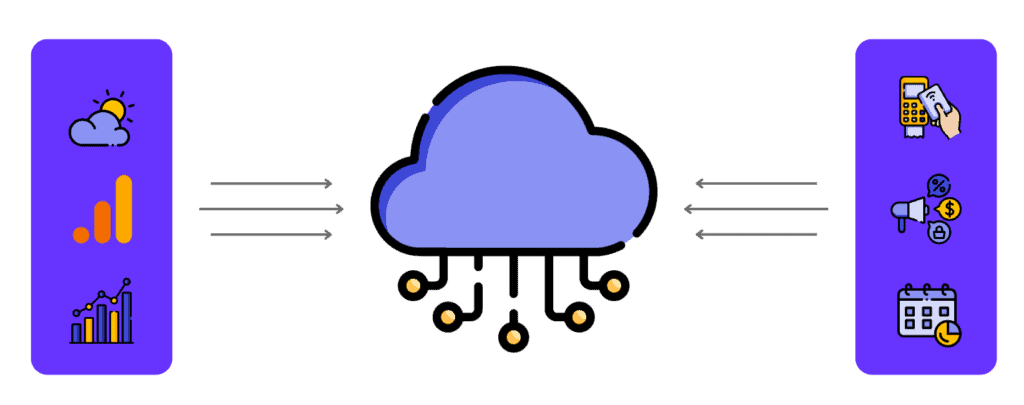
For retailers, demand sensing happens at the store-SKU and omnichannel level. Fresh POS data, promotion details, price changes, and online traffic trends reveal where demand is surging or stalling. This allows for daily replenishment adjustment, micro-allocations across stores and online fulfillment centers, smarter promotional buffers, and targeted markdown strategies when needed.
Both sectors rely on external factors like hyperlocal weather, especially for sensitive categories. Advanced planning tools can automatically take these variables into account, ensuring production schedules and inventory deployments adjust with what shoppers are actually buying. 

Independent research shows that AI-enabled demand sensing can reduce short-term forecasting errors by 20–50%, cutting lost sales and inventory costs in the process.

Data Integration for Demand Sensing

The best platforms blend internal, retailer, and external signals:

  • Internal: orders, shipments, on-hand and in-transit inventory, price changes, assortment, and planned promotions.
  • Retailer: POS by store and SKU, network inventory, and retailer campaign calendars.
  • External: weather forecasts and anomalies, competitor actions, local events, macro indicators, web and app traffic, search trends, and social sentiment.

High performers don’t just collect these; they reconcile them to the short-term planning horizon and refresh daily. 

How Demand Sensing Works in Practice

Demand sensing solutions usually have three components, working together like a radar system for your supply chain. Just as a radar system constantly scans the environment for incoming objects, demand sensing continuously monitors your market for subtle signals of changing demand. The three main components are:

  1. Data ingestion and quality: Connect to POS feeds, ERP, pricing, promo calendars, and third-party data such as weather. Validate and standardize so the signals are comparable. 
  2. Feature engineering and modeling: Transform raw signals into usable features, promo flags and depth, weather deltas vs. seasonal norms, halo and cannibalization indicators, and stockout corrections, then apply ML models suited for short windows. 
  3. Continuous learning: Reconcile short-term signals with the baseline plan and re-optimize frequently. Make updates visible to replenishment and allocation so actions follow insight. 

The Solvoyo Take: From Sensed Signal to Action

Many teams stop at insight. Solvoyo goes further—connecting sensed demand to automated recommendations across replenishment, allocation, and procurement.

  • Weather-aware forecasting: Solvoyo natively incorporates weather data and other external drivers alongside internal history to lift short-term accuracy, then feeds the results into replenishment planning to keep shelves ready.
  • Promotion-aware scenarios: Plan baseline vs. promo-lift forecasts, test depth and duration, and reflect those changes in replenishment targets automatically so the DC and the stores are in sync.
  • Demand sensing at SKU-store level: Translate website traffic, click-through, and in-store signals into near-term forecast updates and immediate actions. 
  • One platform for visibility to action: A digital twin brings demand, inventory, and supply into one place so exceptions, what-ifs, and prescriptive moves sit side by side.

See how Solvoyo unifies demand, inventory, and replenishment on one platform.

Demand Sensing FAQ

No. Manufacturers benefit by sensing downstream POS and retailer inventory to stabilize production and deployment.

Most teams begin with 2–8 weeks, then expand once data pipelines mature.

You need consistent POS and promo calendars, basic out-of-stock correction, and a reliable weather feed. Data gets cleaner once the process runs every day.

No. It reduces routine overrides and highlights exceptions where human judgment adds the most value.

Inbound Logistics Guide for Maximizing Fleet Utilization

When it comes to inbound transportation planning, many manufacturers face the same dilemma: how to ensure raw materials and semi-finished goods flow smoothly from multiple suppliers into production facilities without racking up unnecessary costs or delays. The reality is that traditional approaches to inbound logistics, often based on MRP outputs and manual scheduling, frequently fail to balance supplier calendars, vehicle capacities, and Just-in-Time (JIT) requirements. The result? Half-empty trucks, missed delivery windows, bloated safety stocks, and avoidable logistics costs.

The Inbound Logistics Challenge

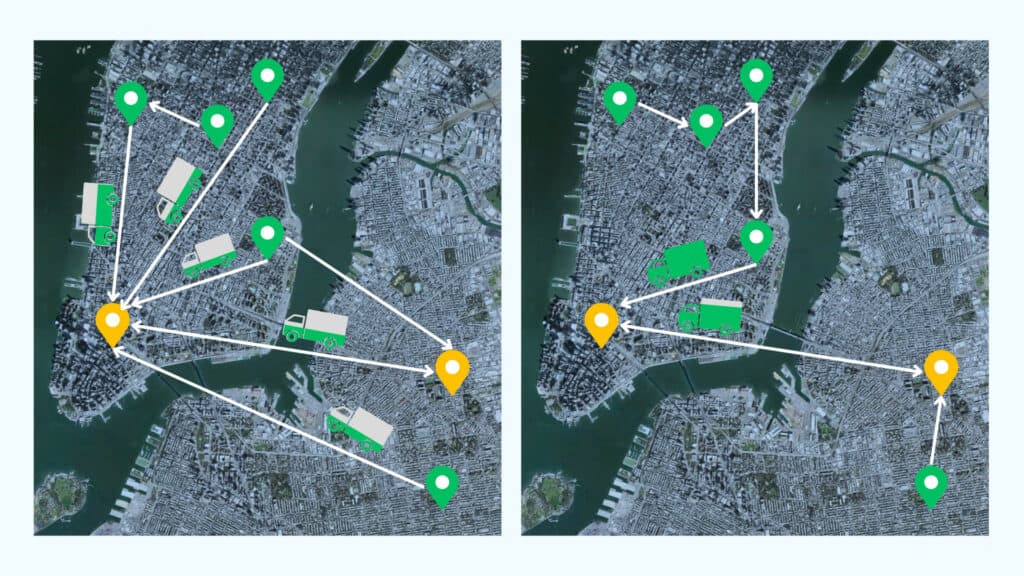
In many industries, inbound shipments follow a ‘milk-run’ model, where vehicles must collect materials from multiple suppliers before heading to the plant. 

two logistics and transportation plan side by side showing the advantage of using advanced optimization models to increase fleet utilization

On paper, it’s efficient. In practice, it’s riddled with logistical challenges and constraints that make execution complex:

  • Supplier calendars and shift patterns mean pickups can’t happen whenever you want.
  • Vehicle compatibility rules (trucks vs. trailers, urban restrictions, high-volume lanes) limit what can be dispatched where.
  • Material and packaging requirements prohibit mixing product types in the same load, complicating consolidation.
  • Strict delivery time windows and JIT inbound logistics commitments demand precise sequencing.
  • Minimum stock levels and inventory tracking must be upheld without tipping into excess.

Ignoring these constraints leads to exactly what most supply chain executives dread: excess empty miles, poor fleet utilization, delivery delays, and ultimately higher costs with lower service reliability.

The Digital Backbone of Inbound Transportation Planning

At the heart of this transformation is a digital planning backbone that integrates seamlessly with ERP, TMS, and WMS systems. Gartner highlights inbound logistics planning as a critical area where digitalization drives efficiency and resilience, underscoring the need for advanced tools that replace manual scheduling with data-driven decision-making.

By leveraging real-time telematics, predictive analytics, and AI-driven inbound transportation planning engines, supply chains can move from firefighting to continuous improvement. This is the foundation for effective inbound logistics optimization.

Key enablers include:

  • Automated data ingestion from ERP systems, replacing manual Excel uploads.
  • Configurable rules and master data management to capture evolving business constraints (e.g., delivery windows, vehicle restrictions).
  • Interactive dashboards and KPIs that track utilization, cost, and on-time performance in real time.
  • Continuous optimization loops that embed sustained performance gains into daily inbound logistics operations.

Why Inbound Logistics Optimization Is Critical for Supply Chain Efficiency

The way forward lies in orchestrating all these moving parts through advanced inbound logistics optimization and decision automation. Instead of daily plans built in silos, an integrated system considers all constraints at once, balancing fleet utilization, cost, and service commitments. This is where optimization modeling becomes a game-changer.

By mathematically representing real-world logistics constraints and objectives, an optimization model transforms inbound transportation planning from guesswork into a structured, data-driven decision-making process.

Benefits of Inbound Logistics Optimization Models

Holistic Constraint Management: Optimization models can account for dozens of rules simultaneously, ensuring that the chosen solution is both feasible and cost-effective.

Scenario Planning and Agility: With optimization, planners can evaluate multiple “what-if” scenarios. Whether the objective shifts from minimizing cost to maximizing service or adapting to new regulatory rules, the model adjusts quickly, something manual planning cannot do at scale.

Quantifiable Gains: By improving fleet utilization, consolidating loads more effectively, and reducing delivery variability, companies see measurable benefits: lower fuel costs, fewer trucks needed, and higher service reliability.

Key Constraints in Inbound Logistics Optimization

General Planning Constraints

Optimization Goal: While the default objective is serving demand, models can be reconfigured to prioritize profitability, revenue growth, or service-level improvements.

Delivery Wait-Time: Plans must respect maximum allowable wait times for each delivery, ensuring timely and compliant service.

Product Categorization: Deliveries grouped by product category simplify handling and compliance, but optimization allows consolidation where possible.

Category Splitting: By intelligently splitting product categories across vehicles, models maximize truck utilization without compromising service.

Demand Zone Constraints

Permitted Vehicle Types: Certain zones may only allow trucks or trailers, or mandate specific vehicle types for high-volume deliveries. Optimization respects these rules while still minimizing costs.

Delivery Time Windows: Strict pickup and drop-off windows are non-negotiable in many zones. An optimization model ensures that schedules align with these operational or regulatory windows.

Delivery Constraints

Package and Material Group Compatibility: Models ensure that incompatible products are not loaded together, while still consolidating loads where allowed to reduce trips.

Vehicle Constraints

Stop Restrictions: Some vehicles may be limited to a certain number of stops, impacting routing efficiency. Models factor this in when designing tours.

Cost and Fuel Efficiency: Optimization includes per-kilometer costs, surcharges (tolls, bridges, stops), and fuel consumption differences between loaded and empty states. This ensures that true costs are minimized, not just distances.

Product Constraints

Volume and Loadability: Effective loadability varies by vehicle type and product shape. Optimization accounts for these variances to ensure realistic and efficient vehicle loading.

The Strategic Payoff

When supply chain executives invest in inbound logistics optimization, the results go beyond cost reduction:

  • Improved Fleet Utilization: Fewer trucks doing more work, with lower empty miles.
  • Regulatory Compliance: No surprises at urban gates or restricted delivery zones.
  • Better Service Levels: On-time, in-full deliveries aligned with JIT needs.
  • Sustainability Gains: Fewer kilometers traveled and reduced CO₂ emissions.

Optimization modeling allows organizations to balance service reliability, cost efficiency, and sustainability, turning inbound logistics from a daily firefight into a strategic advantage.

Why This Matters Now

For supply chain executives, the challenge isn’t just moving trucks, it’s balancing resilience, cost-efficiency, and sustainability in a world where every delay or empty run has a ripple effect across the value chain. Inbound logistics optimization reduces waste, improves service, and strengthens the bottom line.

Inbound transportation planning doesn’t need to be a daily firefight. With the right digital tools and optimization strategies, inbound logistics can become a source of competitive advantage.

Discover Solvoyo Transportation Planning Solutions

Inbound Logistics and Transportation Planning FAQ

Inbound logistics optimization is the process of planning and executing the movement of raw materials and goods from suppliers to production facilities in the most efficient way possible. By using digital tools, optimization models, and real-time data, companies can reduce costs, improve fleet utilization, and ensure on-time deliveries.

Optimization ensures that trucks are fully loaded, routes are efficient, and delivery schedules align with supplier calendars and JIT requirements. This reduces empty miles, maximizes the use of available capacity, and lowers overall transportation costs.

Modern inbound transportation planning software enables automated data integration, real-time visibility, and advanced optimization. Companies benefit from fewer trucks on the road, lower fuel costs, better service reliability, and improved sustainability through reduced CO₂ emissions.

Solvoyo’s AI-powered supply chain planning platform brings together inbound transportation planning, fleet optimization, and decision automation in one integrated solution. By modeling every constraint, automating repetitive tasks, and enabling real-time scenario planning, Solvoyo helps companies maximize fleet utilization, cut costs, and improve service reliability,  all while reducing environmental impact.

Talk to our experts to see how Solvoyo can transform your inbound logistics operations.

İlham Veren Solvoyo Hikayeleri: Annelik ve Kariyer Dengesi

Solvoyo’da her gün sadece iş değil, aynı zamanda ilham veren hikâyeler de üretiliyor. Bu kez iki çocuk annesi ekip arkadaşımız Merve Şimşek ile bir araya geldik; STEM yolculuğunu, anneliği ve kariyerini nasıl dengelediğini, Solvoyo’da çalışmanın bu süreçte ona nasıl bir alan açtığını konuştuk. Onun deneyimlerinden yola çıkarak hem anneliğin hem de profesyonel hayatın aynı çatı altında nasıl güçlenebileceğini birlikte keşfedelim.

1. STEM alanına yönelme kararınız nasıl şekillendi? Bu karar, toplumun ya da ailenizin size biçtiği rollerle çatıştı mı?

Benim STEM alanına ilgim çocukluk yıllarımda başladı diyebilirim. Her zaman her şeyin nedenini, kökenini sorgulayan; olanı olduğu gibi kabul etmek yerine “daha iyisi nasıl olabilir?” diye düşünen bir çocuktum. Bu yönüm, zaman zaman özellikle anne babamın başını ağrıtsa da, hiçbir zaman şikâyet etmediler. Aksine, merakımı beslemek ve beni desteklemek için ellerinden geleni yaptılar. Öğrenme konusunda önüme hiçbir engel koymadılar, tam tersine her fırsatta yolumu açtılar.

Çocukluğumdan beri mevcut bir sistemin nasıl daha verimli çalışabileceğini, nasıl daha çok fayda sağlayabileceğimi düşünmeyi sevmişimdir. Bu, eğitim hayatımda da bana yol gösterdi. Okul hayatımda kendimi daha başarılı hissettiğim alanlar doğrultusunda yönlendim; matematik ve fen her zaman sosyal derslere kıyasla çok daha fazla ilgimi çekti. O dönemde sosyal dersler büyük ölçüde ezber gerektiriyordu ve ben ezber konusunda kendime pek güvenmezdim. Bu nedenle yönüm zaten doğal olarak STEM’e kaymıştı.

Ailem bana kariyer seçimim konusunda asla bir rol biçmedi. Seçimlerimde hep yanımda oldular ve desteklerini hep hissettirdiler. Toplumsal bir baskı da hissetmedim ancak yakın çevremden, özellikle baba mesleğini seçmem konusunda çok yönlendirmeler oldu. Babam mesleğinde çok başarılı bir ekonomistti ve özellikle üniversite tercih döneminde, o alanda bir seçim yapmamın, sonrasında onunla birlikte çalışmamın çok daha mantıklı bir yol olduğu sıkça dile getirildi. Ama onun yaptığı işi çok karmaşık ve kendime çok yabancı buluyordum. Kendimi o ortamda hayal edemiyordum. Zaman zaman “acaba nasıl olurdu” diye düşündüğüm olsa da, kendimi daha güçlü hissettiğim alanda ilerlediğim için hiçbir zaman pişmanlık duymadım.

2. Eğitim veya kariyer yolculuğunuzda “bu alan kadınlar için değil” mesajını açık ya da örtük şekilde aldığınız oldu mu? Bu durum sizi nasıl etkiledi?

Bir zamanlar yalnızca erkeklerin eğitim alabildiği, sonradan karma hale gelen bir liseden mezun oldum. Üniversitede bilgisayar mühendisliği okurken de erkek öğrenci ve hatta erkek öğretmen sayısı çoğunluktaydı. Buna rağmen eğitim hayatım boyunca “bu alan kadınlara göre değil” şeklinde bir imayla hiç karşılaşmadım. Farkındalık düzeyi yüksek, etrafını yücelten insanlarla aynı ortamda olduğum için kendimi şanslı hissediyorum.

Yine de zaman zaman erkeklerin daha avantajlı olduğu bir çevrede yer aldığımı düşündüğüm oldu. Ancak başarabildiğimi görmek bana güç verdi. Dolayısıyla, o dönemde böyle bir mesaj gelse bile kendi güvenlik duvarımdan sekip gitmiştir diyebilirim.

Fakat kariyer yolculuğumda çevre değişince işler biraz değişti. Cinsiyet rekabetini ve kadın olmanın dezavantajlarını kurumsal hayatta bazı erkek ve hatta bazı kadın çalışanlar karışısında daha çok hissettim. Yine de bu deneyimler beni yıldırmak yerine daha da güçlendirdi.

3. Toplumda hâlâ yaygın olan “annelik ile kariyer bir arada yürümez” yargısıyla siz nasıl baş ettiniz?

İki çocuklu bir anne olarak aynı anda hem yüksek lisans yaptım hem de çalıştım; ancak bu dengeyi kurmak her zaman kolay olmadı. Açık konuşmak gerekirse, annelik sürecimin başında bir süreliğine iş hayatına ara vermiştim. O dönemde tamamen çocuğumun ihtiyaçlarına odaklanmak istedim. Zor ama aynı zamanda dönüştürücü bir süreçti.

İşe geri döndüğümde ise kariyerime kaldığım yerden devam etmenin mümkün olduğunu görmek beni çok motive etti. Bu noktada beni en çok destekleyen unsur, çalıştığım kurumun anlayışlı ve kapsayıcı kültürü oldu. Özellikle çocuklarımla ilgili ihtiyaçlarım olduğunda her zaman anlayışla karşılandım. Eşimle sorumlulukları dönüşümlü paylaşmamız da bu dengeyi kurmamda büyük rol oynadı.

“Annelik ve kariyer bir arada yürütülemez” yargısıyla birebir mücadele etmek zorunda kalmadım ama bu dengeyi sağlamak için hem sistemsel hem kişisel olarak doğru koşulların oluşması gerektiğini yaşayarak öğrendim.

4. Anne olduktan sonra STEM alanında çalışmaya dair algınızda ne değişti? Bu dönüşüm sizin çalışma stilinizi nasıl etkiledi?

Özellikle uzaktan çalışmaya elverişli olması nedeniyle teknoloji sektörünün, diğer sektörlere kıyasla anneler için daha avantajlı olduğunu düşünüyorum. Ancak benim pozisyonumda, sistem hatalarına karşı her an tetikte olmam gereken bir sorumluluk var. Bu durum, çocuklarımla geçireceğim zamanın etkilenmemesi adına beni daha kontrollü, planlı ve yedekli çalışmaya yöneltti. Bu da çalışma disiplinime olumlu yansıdı diyebilirim.

5. Solvoyo’daki çalışma düzeni anneliğinizi ve kariyerinizi dengeleme konusunda size nasıl bir alan açtı?

Daha önce de belirttiğim gibi, iş yerim konusunda gerçekten kendimi şanslı hissediyorum. Solvoyo’daki esnek ve anlayışlı çalışma düzeni, hem annelik hem de kariyer rollerimi sağlıklı bir şekilde sürdürebilmem için bana geniş ve destekleyici bir alan sundu.

Çocuklarımla ilgili bir ihtiyaç doğduğunda, bunun bir “engel” olarak değil, hayatın doğal bir parçası olarak görülmesi beni son derece rahatlattı. Sürekli tetikte olmam gereken bir pozisyonda çalışmama rağmen, bu destek sayesinde işimi aksatmadan sürdürebildim ve aynı zamanda annelik rolümü de gönül rahatlığıyla yerine getirebildim.

6. Kurum kültürü açısından, “anlaşıldığımı, desteklendiğimi hissettim” dediğiniz bir anı bizimle paylaşır mısınız?

Çocuklarımın arka arkaya hastalandığı ve “bu hastalıklar hiç bitmeyecek galiba” dediğim bir dönemde işler oldukça yoğundu, sistemsel bir geçiş sürecindeydik ve sorumluluğum fazlaydı. Buna rağmen hiç sorgulanmadan, neye ihtiyacım varsa önce o gözetildi. Önemli bir toplantıya hastanede olmam nedeniyle katılamayacaktım ve toplantıyı ertelemek zorunda kaldığımda gerçekten samimi bir destek gördüm. Bu sayede hem görevlerimi planlayabildim hem de içim rahat şekilde çocuklarımın yanında olabildim. O an sadece bir çalışan değil, bir birey olarak değer gördüğümü hissettim ve bu benim için çok kıymetliydi.

7. Kadınlara fırsat eşitliği sunmak sadece İK politikalarıyla mı olur? Yoksa kültürle mi? Sizce Solvoyo bu konuda nerede duruyor?

Bana göre kadınlara fırsat eşitliği sunmak yalnızca yazılı politikalarla değil, kurumun günlük yaşantısına yerleşmiş kültürüyle mümkündür. Kurallar bir çerçeve sunabilir ama asıl farkı, insanlar ve liderlik anlayışı yaratır. Solvoyo’da yalnızca kâğıt üzerinde değil, günlük pratikte de kadın çalışanların anlaşıldığını, desteklendiğini ve güçlendirildiğini hissettiren bir kültür var. Bu yaklaşım sayesinde kendimi güvende ve motive hissediyorum.

8. Bugün STEM alanına adım atmayı düşünen genç bir kıza bir cümleyle ne söylersiniz?

STEM yolculuğu, kendini her gün yeniden inşa etmeyi göze alanlar içindir; hayal gücünse en sadık yol arkadaşın olacak. Kendine inan, potansiyeline güven, çünkü bir kadının dokunuşu bu yolculuk için elzemdir.

9. Çalışma hayatında eşitlik sadece sayılarda mı gizli sizce, yoksa günlük pratiklerde mi? Siz kendi deneyiminizde bu farkı nerelerde en çok hissettiniz?

Eşitlik yalnızca oranlarla ya da yüzdelerle değil, her gün iş hayatında yaşadıklarımızla ölçülür. Ben en çok, özel hayatımla özellikle de çocuklarımla ilgili ihtiyaçlarım karşısında anlayışla karşılandığımda, toplantılarda fikirlerime değer verildiğinde ve cinsiyetim değil yetkinliğim üzerinden değerlendirildiğimde bu farkı hissettim.

Sayılar elbette bir gösterge olabilir; ancak günlük yaşamdaki tutumlar ve davranışlar, gerçek eşitliğin nerede durduğunu çok daha net ortaya koyar.