

Markdown optimization (also spelled markdown optimisation) sets the timing, depth and location of each price reduction, so that end-of-season stock sells through by its exit date at the best lifetime gross margin. In retail, it replaces fixed discount calendars with a forecast of how each style will sell at each price, in each store or channel.
What Is Markdown Optimization?
Markdown optimization recommends when to discount each style, by how much and where. It weighs each product’s current price, stock level, remaining shelf life, lifecycle stage and seasonality. The first goal is to clear excess inventory without giving away more margin than the clearance needs.
Product lifecycles, seasonal demand, assortment changes, new stores and price competition all shift after the buying decision, so the original price plan rarely holds to the end of the season. Markdown optimization in retail updates the plan as sales come in.
A successfully implemented markdown optimization generates significant additional value to your business such as a rise in revenues, increased margins, better sales conversions, and optimal inventory. However, many retailers face difficulties in implementation because of the challenges in determining the markdown levels, timing, and selecting the right products for markdown.
While some retailers treat markdown as an in-season liquidation tactic and as an opportunity to course-correct with new information, some others have embraced markdowns as a strategic way of attracting a different type of customer, ‘the bargain shopper’, who normally does not shop at regular ticket prices. Whether they are being used to attract a different customer segment, or just as a tactic to clear the older merchandise to make room for the next season, one of the biggest in-season decisions retailers face, that has a direct impact on the bottom line, is how and when to execute markdowns. Taking an analytical and systematic approach to answer the following questions has been proven to have a direct impact on a retailer’s gross margin:
- Which styles should be marked down?
- What is the right depth of markdown to achieve the best lifetime profitability?
- What is the right frequency of progressive markdowns?
- Is there a benefit to starting the markdown of some styles early in the season?
- Do all locations need the same level of markdown at a given time, is there a benefit in localizing markdown decisions?
Today, most apparel retailers have embraced markdowns as a way of life and plan on selling a certain percentage of the stock at a markdown. Some even invest in styles with the intention to sell more than half of the units in the markdown period. Whether it is 20% or 40% of the sales, markdown management is a critical part of margin maximization for a retailer and that is why more and more apparel retail companies have invested in markdown optimization technology over the last fifteen years.
Markdown Optimization in Retail: The End-of-Season Decisions
Each of the five questions above has a practical answer once the forecast responds to price:
- Which styles to mark down: the styles whose forecast sell-through at the current price misses the exit date. A style that is selling on plan keeps its price, however old it is.
- How deep: the smallest discount that clears the remaining units by the exit date. A deeper cut gives margin away; a shallower one leaves stock for a bigger cut later.
- How often: progressive markdowns let the forecast correct itself between steps. The right cadence depends on how quickly each style’s sales respond to a price change. Solvoyo’s markdown optimization recommends each style’s price step week by week, by store cluster, as in the planning screen below.
- Whether to start early: a small markdown on a slow style in mid-season often costs less margin than a deep clearance at the end, because more selling weeks remain to absorb the stock.
- Whether to localize: stores and channels with different shoppers, stock levels and competitors respond differently to the same price. Pricing by store cluster or location captures that, within the price points and rules the business sets.
4 Factors to Consider for Markdown Optimization
In a world where most apparel retailers place purchase orders with their suppliers many months in advance of the season, effective planning requires accurately assessing future customer needs and preferences. Successful retail apparel planners must balance product risks, predict competitive offerings, be aware of the macroeconomic landscape that can impact costs and international markets, and estimate the right buy quantities to maximize sales and margins. Between the time when buying decisions are made and the time products start selling in various sales channels, some factors can impact the actual in-season sales:
1) Changing customer needs
Customer preferences evolve over time and differ from one market to another. Customers may love certain products one year but not the next. Forecasted demand may change as customers already have the basic styles in their closets, or they may come back for it if similar products are offered with even a slight modification. Customer responses can vary by style, perceived quality, end-use of the product, and by price point.
2) Competitive landscape
As new competitors enter the market, or existing ones develop new products or price offerings, market dynamics change from one year to the other, which may impact a retailer’s value proposition in the eyes of the customers.
3) Product risks
There is always a certain level of risk with fashion products. There are limited capabilities to test apparel in the market, therefore there is always an ongoing challenge of setting the right value proposition for each product when there are hundreds of them being introduced every season.
4) Macroeconomic factors
Fluctuations in currencies, inflation rates, and government policies can have an impact on the cost of goods and reduce the planned gross margins which may require adjustment in prices by the retailer, which means taking risks on the acceptance of the new pricing structure by the customers.
These risks and the absence of a crystal ball when making pre-season buying and pricing decisions have made Markdown Optimization a critical part of in-season management and a way of maximizing profits.
Two Approaches in Markdown Management: Rule-Based vs Optimized Markdown Pricing
1. Rule-Based Methodologies
There are different ways a retailer can approach markdown management; some have adopted rules-based methodologies including:
Fixed % discount buckets
Putting styles from the prior season on a fixed discount (such as 30%) and then increasing the discount percentage progressively until the final exit date for the collection. This is one of the simplest and easiest approaches operationally. However, the same level of discount will result in more popular styles selling out while some others may not sell at the same rate and the retailer often ends up giving away margin on certain styles while having to keep discounting others for much longer than the exit date.
Fixed price buckets
Another approach is to split styles into different price offers (low, medium, high) ending with .99 based on the initial prices such as 9.99, 19.99, and 39.99. Here, too, selected price points may be too deep of a discount for some styles and not deep enough for others. Single price points can also lead to the devaluation of the styles in consumers’ minds.
Fixed pricing across all sales locations
There is also the question of whether all locations should execute the same markdown prices for a given product. Single markdown pricing across all locations makes the execution and the messaging much simpler. Keeping the markdown prices across the whole chain is easier to manage and communicate to the customer and keeps pricing consistent across different sales channels. However, in markets where there are differences between shoppers in different locations in terms of style preferences, response to pricing, and competitive factors, there might be a need to tailor pricing strategies by store groups or clusters.
More than fifteen years of using markdown optimization technology has proven that the more granular and analytical approaches to markdown pricing across styles and locations results in an improvement of at least 200 basis points of gross margin.
Different markdown prices across styles
This approach is driven by a markdown optimization system that considers each style’s current price, current stock, and planned shelf life. It also incorporates forecasts based on selling price and lifecycle profile, evaluates financial scenarios for all acceptable price points, and recommends the optimal markdown price at the chain level to achieve goals set by the user.
Different markdown prices by style and by location
This requires a more involved optimization and forecasting capability as each location or store cluster is evaluated independently for the optimal markdown price for a given style. Therefore, differences in customer purchase behavior, and/or inventory levels across locations can lead to different price recommendations for a given style.
2. Optimized Markdown Pricing: A More Analytical Approach to Markdown Management
Retailers who have tried different approaches to markdowns agree that to maximize gross margins, markdown pricing tools need to take maximum advantage of big data analytics, and real-time POS and inventory data. Markdown tools also need to be flexible, scalable, easy to configure for different levels of granularity, and facilitate easy decision-making at all levels of the organization.
How to Choose Markdown Optimization Software
Ask each vendor to run its markdown recommendations on a sample of your own styles and stores, then check these eight points:
| What to check, and why | What to ask in the demo |
|---|---|
| Forecasts for new styles. Many fashion styles are new each season. | How do you forecast a style that has never sold? |
| Price response by style and location. The same discount moves a slow style and a bestseller very differently. | Show expected sales at three price points for one style in two stores. |
| Your objective, set per scenario. Some weeks the target is sell-through by the exit date, other weeks lifetime gross margin. | Can I switch the objective and compare both scenarios? |
| What-if scenarios with financial impact. Planners need revenue, units and margin before they approve. | What happens to margin if I override this recommendation? |
| Business rules. Price endings, minimum discounts and local price lists must hold. | Where do I set price points and minimum discount levels? |
| Approval and tracking. Approved prices have to go live and be measured against the plan. | What share of your recommendations do customers accept untouched? |
| Scale. Thousands of styles across many stores, channels and countries. | How many markdown recommendations does your largest customer run? |
| Data and price execution. The model needs sales, stock and price data, and approved prices must reach stores and channels. | Which systems feed the model, and how do approved prices go live? |
Ask for the margin or sell-through result first, then the share of recommendations planners accept without edits. Solvoyo publishes its user acceptance rate next to the business results it is meant to move.
How Solvoyo Can Help
Solvoyo’s Markdown Optimization solution built on an advanced retail supply chain analytics platform delivers all the necessary solution criteria with an easy-to-use interface and workflow that delivers measurable financial results and productivity gains.
Solvoyo understands the challenges and different aspects of in-season decision-making in apparel retail and offers a suite of products to support merchants and planners in making the most profitable decisions.
Solvoyo’s Markdown Optimization solution is a fast, straightforward way to:
- Maximize lifetime profitability of each style
- Increase inventory turns of the merchandise
- Sell through collections by a target date to make room for fresh merchandise
- Compare different markdown scenarios in terms of the financial impact
It standardizes and streamlines markdown decision-making by combining analytics, number crunching, and user inputs and approvals through a fast and user-friendly interface.
Scenarios can be reviewed at various levels of the merchandise hierarchy and the impacts of accepting the markdown recommendations can be easily assessed in real-time. Configurable summary tables and KPIs provide financial insights including revenue, unit sales, and gross margin for all scenarios.
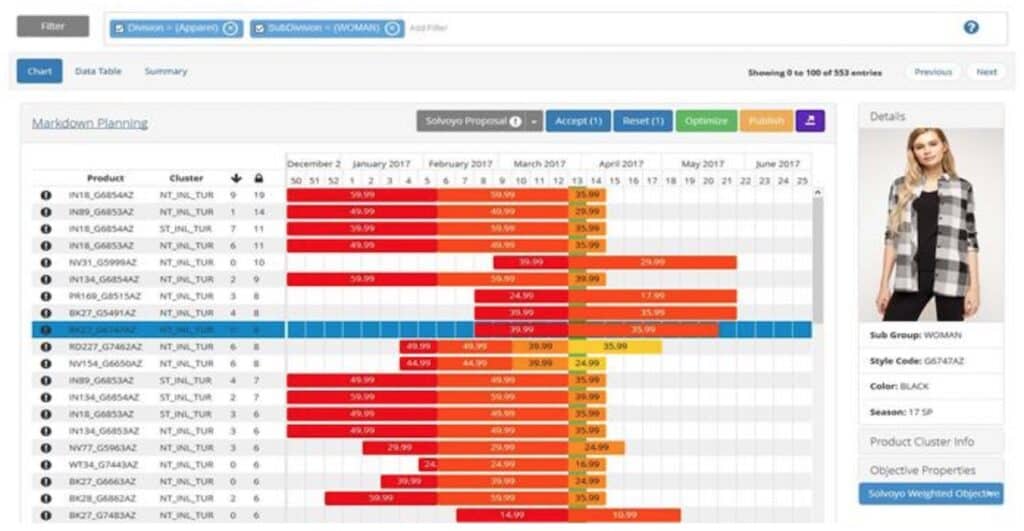
1. Advanced forecasting methodology leverages attribute-based life cycles at the beginning of the selling period and combines with the in-season performance of individual styles
One of the challenges of apparel retail is that many of the new fashion products and styles do not have historical data from prior years. Solvoyo’s attribute-based forecasting works with merchandise hierarchy and style attributes to forecast sales based on lifecycle curves from a group of similar styles and updates the forecasts in season based on a style’s own selling history.
2. User-friendly and versatile what-if analysis enables retailers to evaluate different scenarios in real time and facilitate fast decision-making
With Solvoyo Markdown Optimization, users can evaluate different pricing scenarios such as optimizing sell-through by exit date or optimizing lifetime gross margin, and choose the scenario that fits the company’s strategy for that week. Users can also evaluate the impact of overriding markdown recommendations, change the exit dates of the styles, and review the financial metrics with ease, from the product level to the company level.
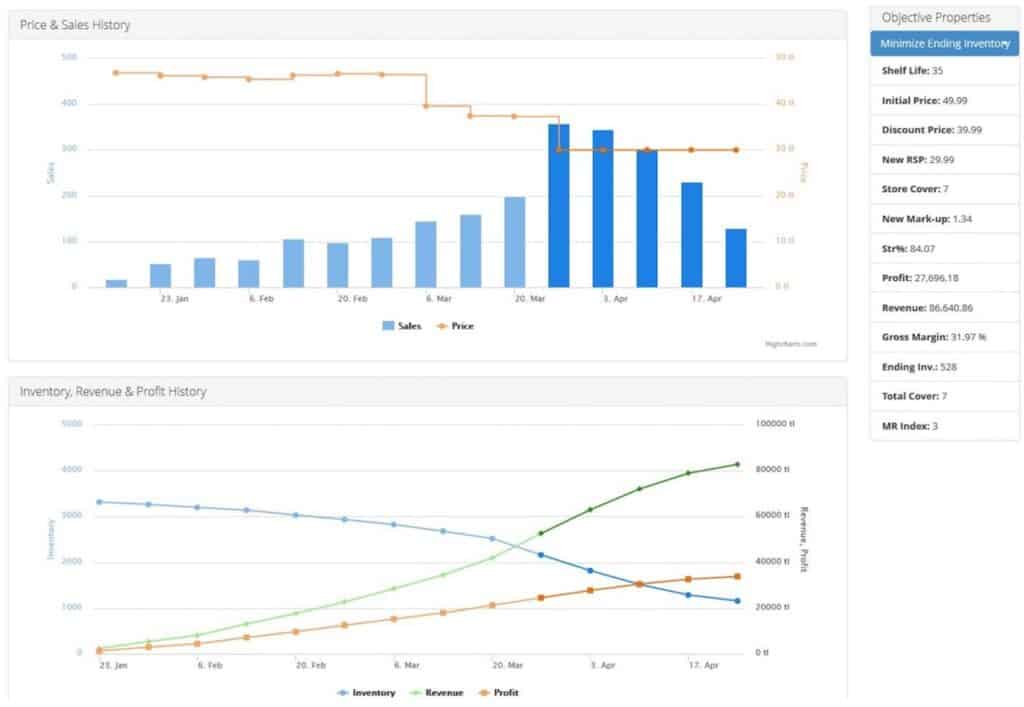
3. Easy to expand to new locations and markets and update business rules as businesses grow and face new challenges
As a business’s needs evolve and change over time, new markets could be added, pricing rules (such as price points or minimum discount levels) can be introduced, and the company may have some business rules to make the execution of markdowns easier for the store operations teams for different regions or groups of stores.
4. Cloud-based Software-as-a-Service solution is flexible, easy to deploy, and minimizes upfront investment
Solvoyo’s cloud-based Markdown Optimization solution is accessed on the web and does not require an upfront investment in hardware or software installations, and doesn’t require lifetime investment into in-house resources to maintain and upgrade.
Result: Markdown Optimization at DeFacto
DeFacto, a fashion retailer with 670 stores in 50 countries, used to plan markdowns in spreadsheets kept by individual planners, with different methods across categories and countries. With Solvoyo, markdowns run on one standardized process for all 50 countries, with local price lists managed in the same solution and millions of automated markdown recommendations.
Gross margin improved by 200 bps, and 80% of markdown decisions are now planned with no manual touch. Read the DeFacto markdown case study.
Using Solvoyo’s Markdown Optimization solution, we now can achieve different business objectives. With an AI/ML predictive life cycle forecasting engine, Solvoyo prevents us from taking unnecessary discounts and thus, minimizing margin lost.
Cem Diken, Planning Director, DeFacto
Markdown Optimization FAQ
Markdown optimization is the planning of price reductions so that each style sells through by its exit date at the best lifetime gross margin. Software forecasts how each style will sell at each price, in each store or channel, and recommends the timing and depth of every markdown.
Ask vendors to run recommendations on your own styles and stores. Check that the software forecasts styles with little history, models price response by style and location, lets you set the objective, shows the financial impact of each scenario, respects your price rules, and tracks what planners accept. Ask what share of its recommendations customers accept untouched.
Start when a style’s forecast sell-through at its current price misses its exit date. For slow styles that can be weeks before the season ends, and an early small markdown usually costs less margin than a deep clearance later. Styles selling on plan can wait. Markdown optimization checks this every week, by style and location.
Dynamic pricing changes list prices often, in response to demand, competitor moves and stock, and is common in e-commerce. Markdown optimization plans the permanent price reductions that clear a season’s stock by its exit date. Solvoyo covers base prices, promotions, dynamic pricing for e-commerce and end-of-life markdowns in one pricing solution.
At DeFacto, 670 stores in 50 countries, Solvoyo’s markdown optimization improved gross margin by 200 bps, with 80% of markdown decisions planned with no manual touch (DeFacto markdown case study). The gain for another retailer depends on how it plans markdowns today.