

Big data analytics for wholesalers and distributors, often called wholesale data analytics, turns ERP orders, stock positions, supplier lead times and customer demand into SKU-level forecasts and replenishment plans that every function works from. Duzey, a wholesale FMCG distributor that supplies 76,000+ retail locations, used this approach on Solvoyo to cut overall inventory investment by 10% and improve forecast accuracy by 20%.
Why Wholesalers Struggle to Turn Data Into Plans
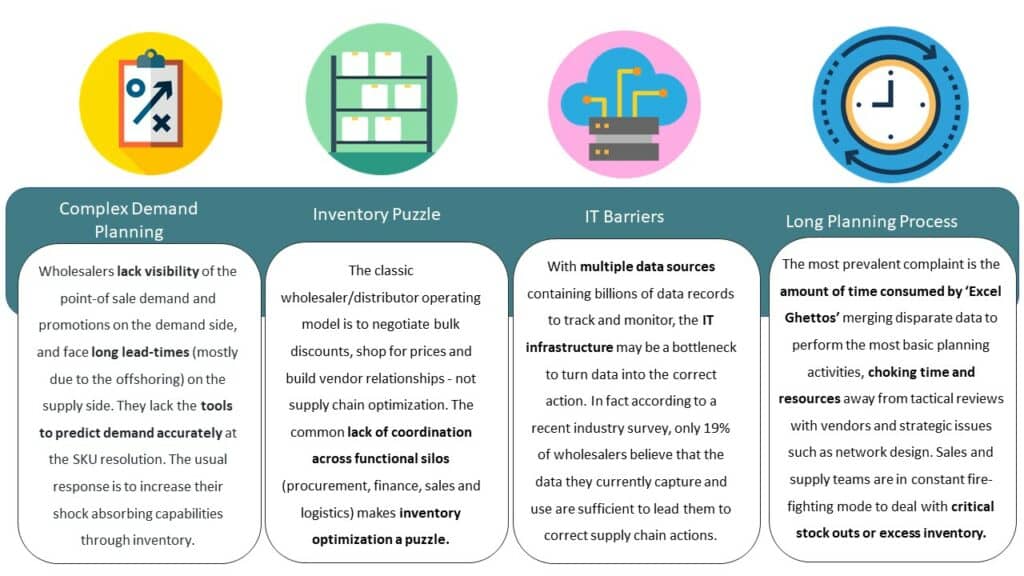
Wholesalers and distributors sit between manufacturers and retailers. They rarely see point-of-sale demand or promotions, their suppliers quote long lead times, and they carry extra inventory to cover both. Ecommerce and direct purchase agreements between retailers and manufacturers make the market more demanding still. For the inventory side of the problem, see wholesale distribution inventory planning by SKU and branch.
Leading wholesalers and distributors still grow and gain market share. They choose either a scale-based cost advantage through M&A consolidation or specialization in niche product areas with differentiated service.
For long-term viability, growth and market share increase must be balanced with improvement in supply chain performance. Only by reducing waste, optimizing inventory and improving customer experience will a wholesaler escape the pack and establish the base for profitable growth in the challenging years ahead.
In short, IT infrastructure with disparate sources of data, lack of visibility into the actual demand signal, manual planning and outdated analytics result in the wrong mix of inventory turns and operating margins with mixed results in customer satisfaction.
A New Planning Approach With Solvoyo
Solvoyo’s cloud-based planning platform has a demonstrable track record of producing significant economic benefits for several of our clients in terms of (i) sales increase due to better product availability, (ii) optimized inventory levels, and (iii) higher gross margins due to less waste or obsolescence. To make the case more tangible, here is how Duzey, a wholesale FMCG distributor that supplies 76,000+ retail locations from 62 distribution centers and 9 regional warehouses, deployed the Solvoyo platform and measured the benefits.
The Problem at Duzey
Before Solvoyo, Duzey faced:
- Critical stock outs at DCs
- Rising stock levels at regional warehouses
- Growing product waste
- No visibility across the whole supply chain, and planning in disconnected spreadsheets
The Solution
Big Data Analytics
The Solvoyo platform is designed to capture a wide range of data and transform them into meaningful analysis. The platform can be configured to automatically (i) bring in detailed business data on both the demand and the supply side, (ii) pipe in additional upstream/downstream data such as supplier/customer inventory, weather, economic stats using our flexible APIs, (iii) combine data across multiple regions, channels, product lines and vendors, (iv) plan fulfillment on the demand side and replenishment on the supply side, accounting for seasonal variations and (v) incorporate marketing insights about the effect of promotions derived from Solvoyo’s statistical approach.
For Duzey, Solvoyo configured the platform so marketing, operations, distribution and finance plan together. Data are automatically pulled in from ERP systems and daily SKU-based forecasts are automatically generated. The web-based collaboration portal allows different teams within Duzey to update the forecasts within the rules of a workflow engine. Final forecasts and the Solvoyo-generated inventory plan form the basis for the replenishment orders to the supplier base.
Integrated Planning Viewpoint
Solvoyo platform provides a common data schema to work across supply chain functions, serving as the single “source of truth” for planning. Planning across functions on one data model reduces planning cycle times, synchronizes flow between echelons, and optimizes performance across competing supply chain functions. Furthermore, better data and synchronized planning also allows more accurate tracking and measurement of the KPIs. Within six months of go-live, Duzey saw gains in demand planning productivity and fewer manual errors, and cut overall inventory investment by 10% without degrading its on-time-in-full (OTIF) performance.
Duzey Results
- 10% reduction in overall inventory investment
- 10% reduction in lost sales
- 15% reduction in waste of perishable stock
- 20% improvement in forecast accuracy
Read the Duzey case study, or see how Solvoyo supports wholesale distribution planning.
Foodservice Distribution: g2m
g2m, a foodservice distributor in Turkey that supplies hotels, restaurants and cafés, runs 17,000+ SKUs through 8 DCs and makes 3,000+ deliveries a day. With clean master data, integrated data sources and semi-automated planning on Solvoyo, it improved OTIF by 40%, truck utilization by 20% and DC pick-and-pack efficiency by 15%. Read the g2m case study
Using Planning Data for Strategic Decisions
Imagine a planning platform that not only supports your daily or weekly planning functions but that also proactively analyses network-wide issues. By acting as your supply chain planning system of record, Solvoyo automatically becomes a reservoir of data from where you can extrapolate strategic insights.
Solvoyo’s wholesaler clients use the platform data to run periodic inventory stratification projects that help them fight the proliferation of SKUs that so often handicaps this industry. You can routinely answer your strategic supply chain questions like: How much can I grow with my current infrastructure? How should I downsize with the least effect on my clients? If I need a new distribution center, where should I put it? Are my transportation lanes optimal? How do I rationalize my facilities post-merger? Which are my problem products or customers or vendors?
Frequently Asked Questions
Predictive analytics for wholesale distribution uses order history, stock positions and promotion effects to forecast demand by SKU and location, then sets safety and cycle stock from those forecasts. At Duzey, Solvoyo generates daily SKU-based forecasts from ERP data, and teams adjust them within a workflow before they drive replenishment orders.
Start with order and shipment history by SKU and location, current stock by warehouse, open customer and purchase orders, and supplier lead times. Then add upstream and downstream data where it exists: supplier and customer inventory, promotions, weather and economic indicators. Solvoyo brings these in through APIs and combines them across regions, channels, product lines and vendors.
Calculate safety and cycle stock from SKU-level forecasts instead of one coverage rule for every item, and let every function plan on the same data. Duzey did this on Solvoyo and cut overall inventory investment by 10% while reducing lost sales by 10%.