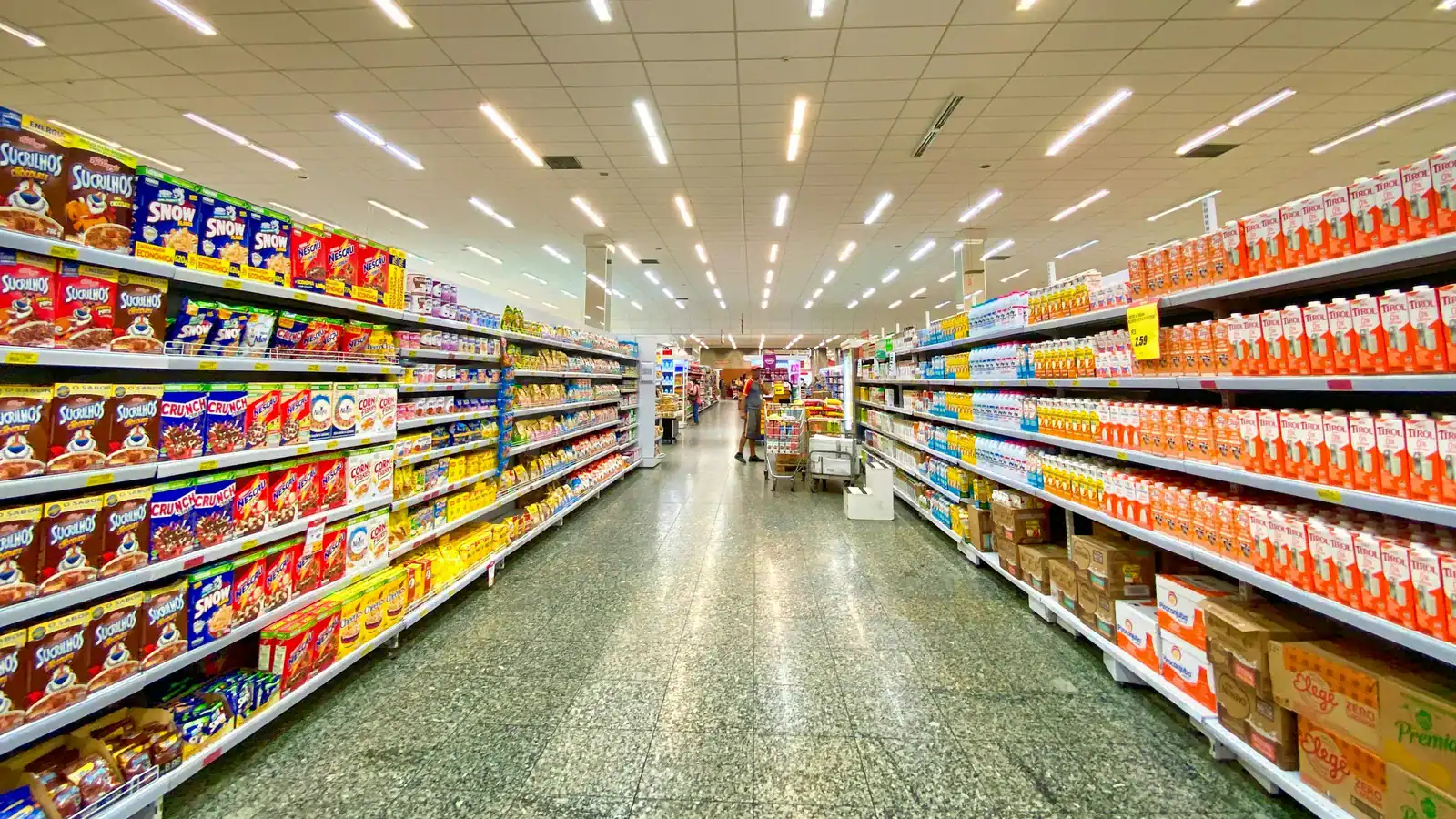

Fresh produce represented approximately 25% of İstegelsin’s total revenue, yet posed the most complex planning challenge in the business: highly seasonal, short shelf-life, dependent on variable harvests, and intolerant of any out-of-stock event. With annual revenues of approximately 800 million Turkish Liras and a growing footprint, the company needed planning intelligence that could match its operational pace.
The Scope of the Operation
The project covered İstegelsin’s entire central-to-store supply chain, with particular focus on its fresh produce crossdock operation, a category that is both its highest-risk and highest-reward planning problem.
23
Active Dark Stores (incl. 2 seasonal)
6,500+
Actively Planned SKUs
700+
Active Suppliers
~25%
of Revenue in Fresh (primary focus)
Fresh Produce Doesn’t Follow Rules
Unlike packaged groceries, fresh produce combines extreme demand volatility with unforgiving supply variability. A strawberry season can shift by two weeks depending on the weather. A truckload arrives 4% lighter than ordered. A product with no history enters the catalog in the middle of peak season. İstegelsin’s planners were managing all of this in Excel — manually, centrally, and reactively.
- Unpredictable Season Start & End Dates — Harvest timing shifts year to year due to temperature and weather — a new season can start 10+ days earlier or later than historical data alone would predict.
- Actual Receipts Differ From Orders — Trucks arriving with 480kg instead of 500kg couldn’t trigger dynamic reallocation in time — the distribution plan was already stale by the time the truck docked.
- Zero Tolerance for Stockouts — If a product was out-of-stock on the web platform, customers couldn’t order it even for next-day delivery — making every unavailability a direct revenue loss.
- Manual, Decentralized Planning — Without dedicated planners in each dark store, all decisions had to be made centrally — but the old process had no automation, no real-time data, and no product intelligence.
An Integrated Engine: Forecasting and Replenishment as One
Solvoyo deployed a unified platform spanning demand forecasting, inventory planning, and real-time crossdock allocation — with each layer informing the others automatically. The key architectural insight: separating forecasting from replenishment for fresh produce was itself the root problem. Solvoyo solved them together.
- Intelligent Product Segmentation — Products were classified into Regular (year-round, short shelf-life), Periodic/Seasonal (harvest-dependent, e.g. green plums, strawberries, cherries), and Special Day (occasion-based, e.g. Ramadan pita bread). Each segment received purpose-built forecasting behavior — and periodic items were automatically assigned a 99% service level target, since no stockout is acceptable for a product that only sells for a few weeks.
- Adaptive Season Start Detection — Rather than relying purely on last year’s calendar, the system combined historical sales patterns, real-time temperature models, and live supplier purchase order signals (POs) to detect when a seasonal product was actually entering market. Planners could also manually override the detected start date with a reason code — and the forecasting engine used that reason to determine how the seasonal curve should shift: whether the peak would arrive later, whether the season would be longer or shorter, and whether the tail should be trimmed early.
- Saleable vs. Physical Inventory Modeling — The platform learned, per location, the typical gap between physical stock and what is actually sellable — accounting for shrinkage, visual rejection by produce staff, and moisture loss. This location-level learning (Antalya versus the Black Sea region behave differently) was fed directly into inventory projections.
- New Product Bootstrapping — For products with no sales history (including tropical fruits entering the assortment mid-season), the system automatically identified the most behaviorally similar existing product and used it as the learning base — enabling accurate allocation decisions from day one.
- Demand Sensing for Fresh Products — Because fresh produce demand can shift significantly from one day to the next — due to temperature, local events, or promotional effects — the platform operated on a daily demand sensing cycle. Forecasts were not static week-level plans; they were recalculated and updated every day based on the latest observed sales, inventory positions, and external signals. For crossdock operations, this sensing ran intra-day: the moment a truck arrived, the system pulled the most current demand picture across all 23 dark stores before calculating the allocation.
- Real-Time Crossdock Allocation — When a truck docked at the central warehouse, its actual contents triggered an instant recalculation across all 23 dark stores — using live stock levels, live forecasts, and shelf-life constraints. Produce was divided at the loading bays without ever entering the warehouse, preserving freshness and minimizing handling time.
- Full End-to-End Automation — Orders were written automatically to İstegelsin’s ERP system — even when trucks arrived at 3am. No planner needed to approve or edit the crossdock allocation; the system operated fully autonomously.
The Crossdock Allocation Flow
The crossdock module is the operational centrepiece of the fresh produce solution. Here is how a typical inbound vehicle event triggers an end-to-end planning cycle in real time:
- Truck Arrives → Actual quantities scanned at dock.
- System Triggers → Live pull of stock, demand sensing & forecasts across all 23 stores.
- Optimization Runs → Maximizes availability, minimizes waste.
- Orders Written → Results pushed to ERP automatically.
- Produce Dispatched → Stock split at loading bays, shipped fresh without entering warehouse storage.
Why Freshness Demands Real-Time
In conventional replenishment, a plan made the previous evening is good enough. For fresh produce moving through a crossdock, it is not. A plan made 24 hours ago does not know that one store sold through its tomatoes overnight, that another received a 5% short delivery this morning, or that an incoming truck contains 480kg rather than the ordered 500kg.
Solvoyo’s engine recalculates the entire distribution at the moment of truck arrival — not the night before, not in batches. Multiple trucks carrying multiple product types can be processed simultaneously, each triggering its own independent optimization that accounts for all in-flight changes across the network.
Product Segmentation Framework
The foundation of accurate fresh forecasting is knowing what kind of product you are planning. Solvoyo defined three distinct behavioral profiles for İstegelsin’s fresh assortment, each with its own forecasting methodology and replenishment policy.
| Segment | Characteristics | Examples | Service Level | Key Planning Logic |
|---|---|---|---|---|
| Regular | Year-round meaningful sales; short shelf-life but no sharp season | Potatoes, tomatoes, garlic, onions | Standard (category-based) | Trend + seasonality learning from own history; promotions modeled |
| Periodic / Seasonal | Only sold during specific harvest windows; zero tolerance for stockout | Green plums, strawberries, cherries, broccoli | Auto-set to 99% | Adaptive season start detection; similar-product bootstrapping; daily curve adaptation |
| Special Day | Occasion-driven, very limited window; tail management critical | Ramadan pita bread, holiday items | High; tail managed by stock-depletion trigger | Season start from supplier PO signal; reason-code driven curve shaping; “sell through” logic to clear tail |
Results Within One Year of Go-Live
The crossdock allocation model covered approximately 25% of İstegelsin’s product scope by revenue, the most operationally complex 25%. Results were measured against the same period in prior years for the fresh product categories managed through the crossdock engine.
+14pt
Increase in Fresh Product Fill Rate
From 72% to 86% availability
Improved
Availability Without an Increase in Waste Ratio
Daily
Demand Sensing Cycle
Forecasts refreshed daily; crossdock triggers run intra-day
What the Numbers Show
The 14-point gain in fresh product availability was achieved within one year of go-live, across the 25% of the product scope managed through the crossdock engine. Results were measured year-over-year against the same fresh product categories — making the improvement directly traceable to the introduction of real-time, integrated planning.
What Solvoyo Deployed
The engagement spanned forecasting, inventory optimization, replenishment, and real-time allocation — delivered as a unified platform with direct ERP integration and a single configuration layer managed by Solvoyo’s Customer Success team.
- Demand Forecasting Engine
- Demand Sensing (Daily + Intra-Day)
- Product Segmentation & Classification
- Inventory Optimization
- Crossdock Allocation Model
- Season Start Detection
- New Product Development (NPD) Similarity Matching
- ERP Integration
- Master Data Management
- KPI Reporting & Analytics
Forecasting and Replenishment, Solved as One
The biggest structural advantage of the Solvoyo platform for İstegelsin was not any individual feature — it was the fact that forecasting and replenishment were solved as a single, integrated system. Insights discovered in the forecasting engine (such as a seasonal product entering market two weeks early, or a specific location showing unusual shrinkage rates) were immediately reflected in replenishment decisions — with no manual handoff, no parameter update, and no delay.
For a business where freshness is measured in days and availability directly determines whether a customer can even place an order, that tight loop between demand intelligence and supply decision is not a nice-to-have. It is the product.
Central to this was demand sensing: the discipline of continuously refreshing forecasts from real signals rather than relying on static weekly plans. In fresh produce, a forecast that is 24 hours old is already stale. By running daily demand sensing cycles — and intra-day triggers at the moment of truck arrival — Solvoyo ensured that every allocation decision was made on the most current picture of demand available.

About Company
İstegelsin, Turkey’s fast-growing Q-commerce player, was a leading Turkish rapid grocery delivery company operating a network of dark stores across multiple cities. Customers placed orders online and received fresh produce, packaged goods, and specialty items within hours, a model where freshness and availability are not just customer expectations, but the core product promise.
Achievements
+14 Fill Rate Improvement
Increased Availability Without Increasing Waste Ratio
Daily Demand Sensing Cycle
Don’t take our word for it
Even though our main goal as an e-commerce retailer was managing growth after we went live, with Solvoyo our inventory turns improved by 61% while our availability increased by 44% and our sales almost doubled.

Using Solvoyo’s Markdown Optimization solution, we now can achieve different business objectives. With an AI/ML predictive life cycle forecasting engine, Solvoyo prevents us from taking unnecessary discounts and thus, minimizing margin lost.

Cash flow in e-commerce is extremely important; the more free cash we generate, the better we operate. It is extremely important for this type of business.The savings run into the tens of millions of dollars.
Even though our main goal engaging Solvoyo as an e-commerce retailer was managing growth, after we went live our inventory turns improved by 61% while our availability increased by 44% and our sales almost doubled.

With a network of 9800 stores, supply chain disruptions and uncertainty are normal for us, we keep opening hundreds of new stores and multiple DCs every year. With advanced analytics and automation, we planned for this level of complexity way ahead of our competitors.